

Post-Postal?
ANNETTE ON THE ROAD Annette explores the venerable history of the US Postal Service. Does it still matter?

Dr. Laing Goes to Washington
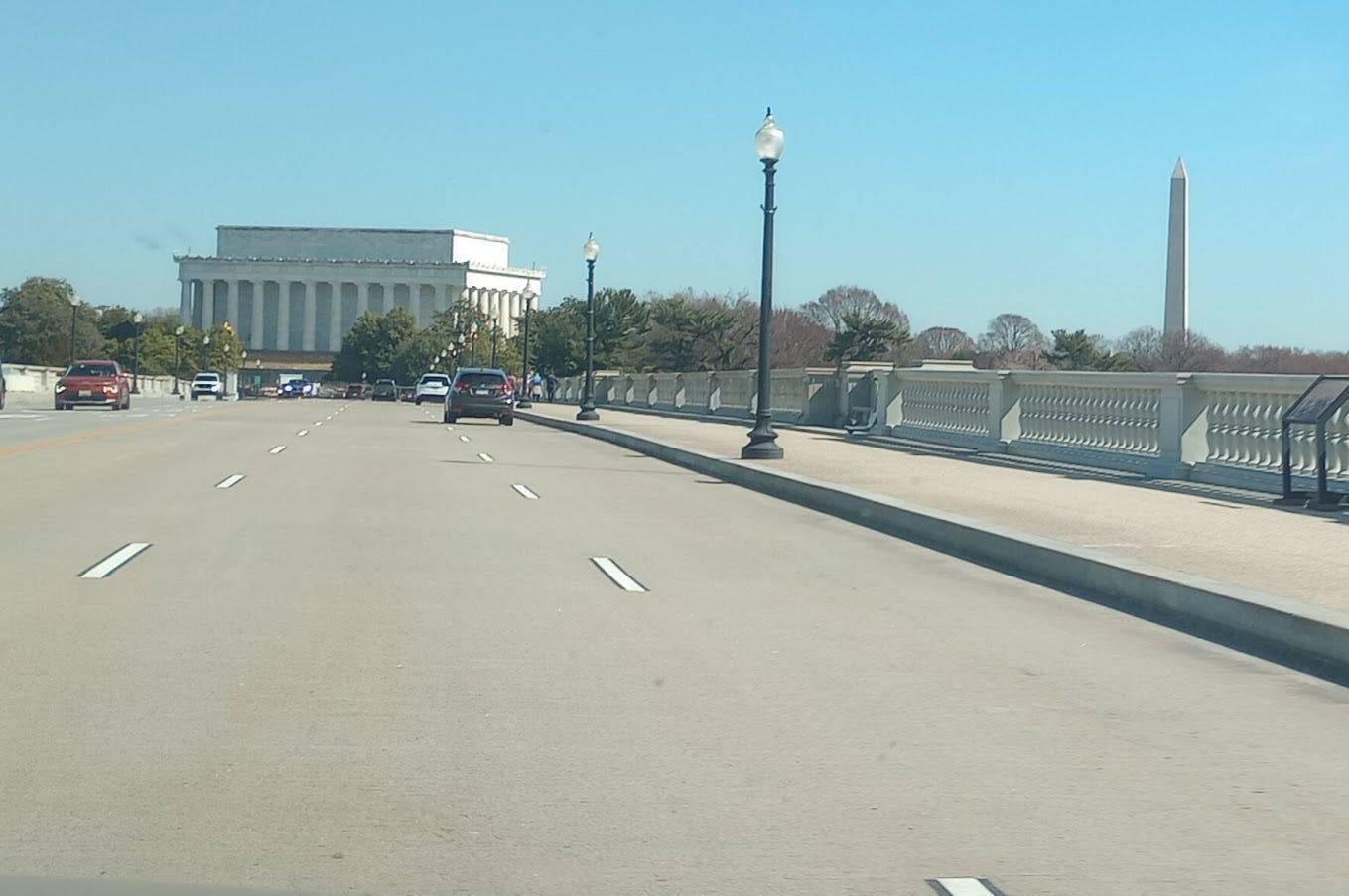
“Look,” I said to Hoosen in the car, “On the right, there’s George Washington’s prototype Mars space rocket! And on the left, Abraham Lincoln’s innovative launching pad!”
We were in Washington, DC, in case you’re wondering.
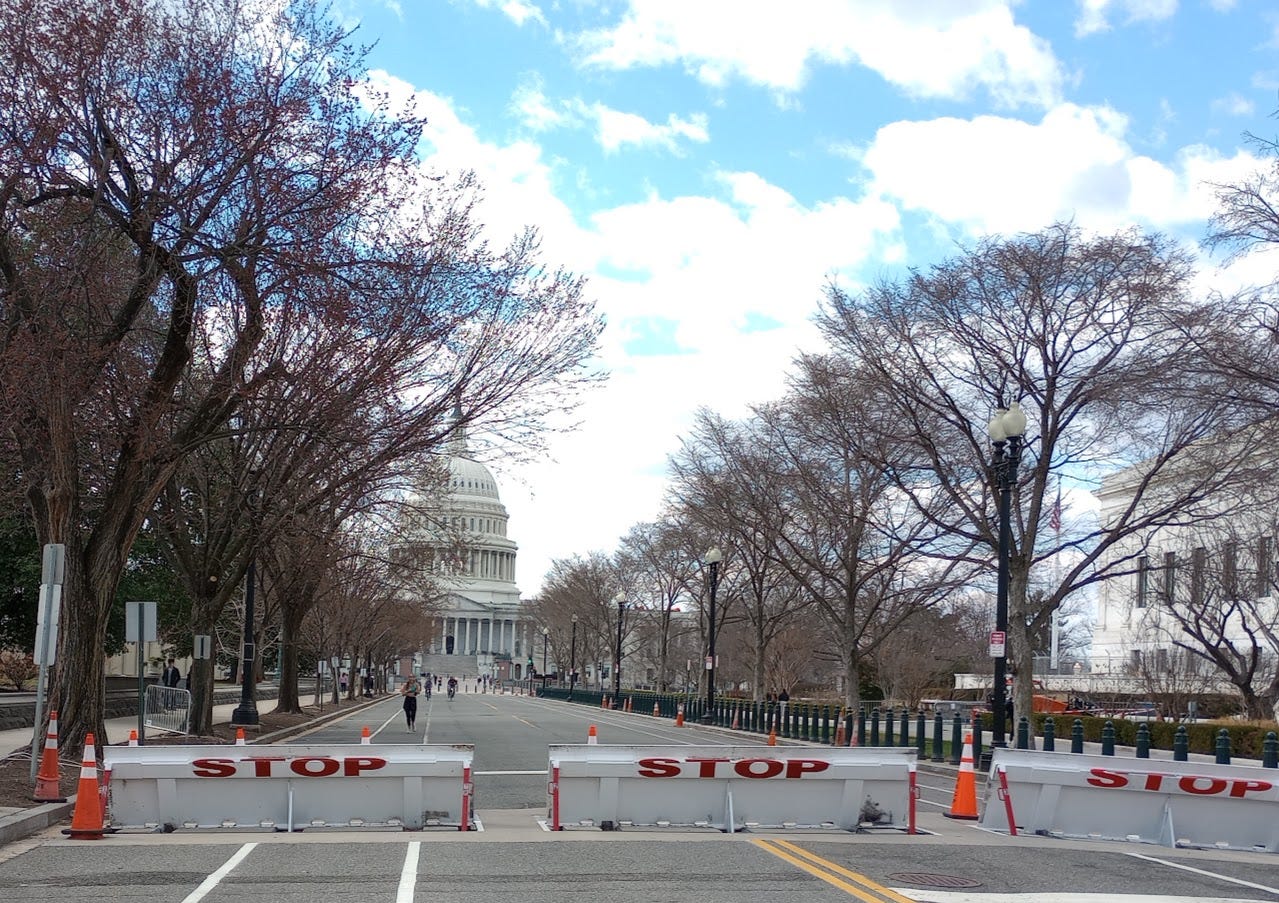
And look, the US Capitol! Welcoming us with STOP STOP STOP! Forgive me for my inept photo, in which the Capitol appears to be tilting to the right.
On our Sunday afternoon outing with Hoosen, Jr. and his lovely girlfriend, we parked on a side street. I looked around me (I’m easily distracted from any mission). “Oh, hey, guys,” I said. “Look! John Marshall’s house! John Marshall, iconic Chief Justice of the US Supreme Court!”
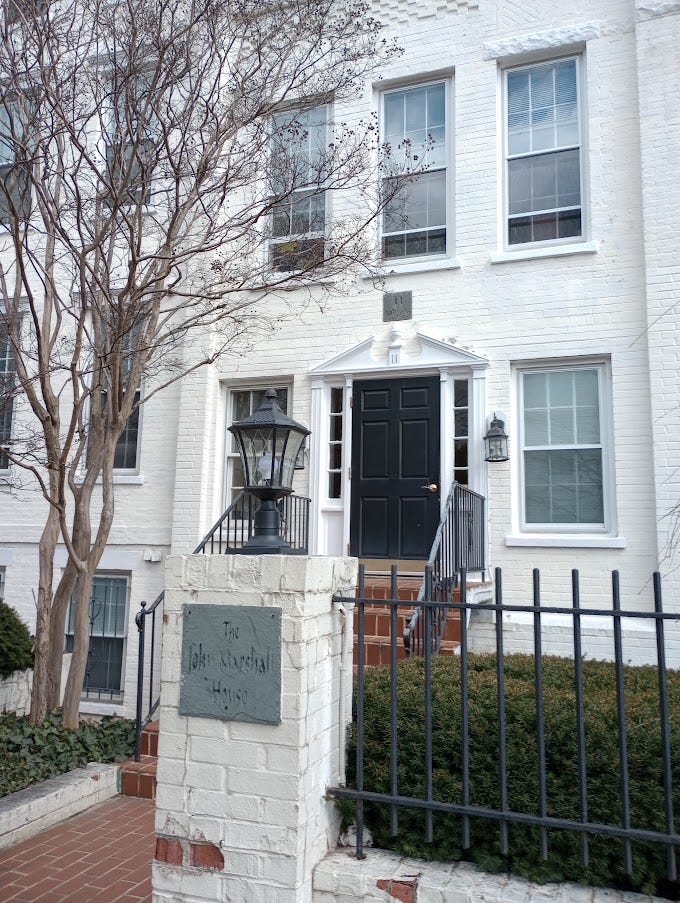
“Or maybe it’s just called The John Marshall House,” I added doubtfully. “Named for him, but not actually his.” Which turned out to be the case. Oh.
And then I peered at the building next door: Florida House. What could this be? A historical marker from 1973, set against a mural of a beachball, explained.


This house belongs to and is for the use of all the people of the state of Florida. Through their contributions the building was purchased and renovated to create Florida House, the first state house in the nation’s capital. It is dedicated to all Floridians in the hope that here they will always find comfort and kindness. (1973)
Comfort and kindness are not words I normally associate with Florida, except maybe the lovely overworked and underpaid “cast members” at Walt Disney World back in the day. Some of these kind Floridians once practically dredged a pond while dodging alligators to retrieve four year old Hoosen, Jr.’s Tigger hat.
But I was most struck by the very idea of Florida House. How weird. “Um, it looks like Florida has an embassy,” I said. “Like, it thinks it’s separate from the US.”
Turns out, yes, that’s exactly what it is. But before my non-US readers think this is normal, let’s be clear: Florida started no trend back in 1973. Florida remains the only state to have a diplomatic mission/hospitality house in the nation’s capital, founded two years after Walt Disney World opened, when Florida looked like it had a bright sunny future. Ahem.
I didn’t think we four would be mistaken for Floridians: We don’t give off that slightly demented Florida vibe. “Maybe they’ll give us a specimen cup of orange juice?” I said hopefully, thinking of the little “Welcome to Florida” freebies we used to collect from the Florida Visitors’ Center on the drive south from Georgia.
Everyone said that this was unlikely. I did wonder though…. AGH! I just looked it up. We would indeed have been greeted with actual glasses of Florida orange juice. Curses. Oh, wait. No, we would have to be Floridians. Well, that’s petty. After all that money we spent at the House of Mouse back in Hoosen, Jr.’s youth.
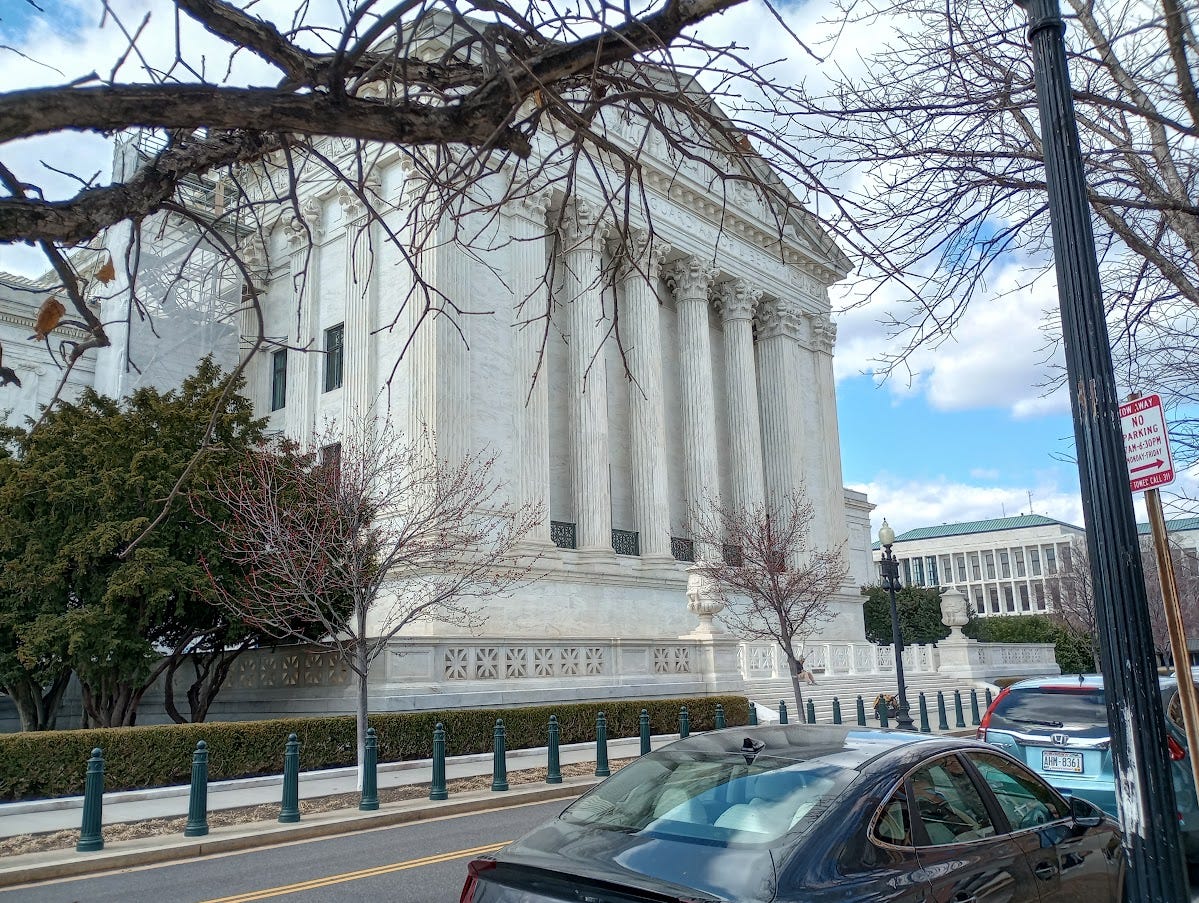
Now I looked behind us. “That’s a grand building,” I said. “I wonder what it is?”
“Um, that’s the Supreme Court, Mum,” said Hoosen, Jr., rolling his eyes.
Not my fault. You don’t usually see it photographed from the back.
Going Postal
This, in case you hadn't guessed, is an Annette on the Road post at Non-Boring History. Although you may not know it, this renegade academic historian took you with her on her family's visit to the National Postal Museum in the heart of Washington DC. That was in April, at a moment when things had never seemed more uncertain for all the institutions housed in the solid grand architecture that defines the capital of the United States.
Why the National Postal Museum, of all things?
Well, I’m of the last generation who wrote letters (and you will be shocked to know, I was a writer of many letters). I miss the joy of regularly getting real mail. Email was thrilling at first: “You’ve Got Mail!” trilled AOL. Ooh!
But the novelty wore off, and who could imagine that so much email would end up being ads, begging letters, and sketchy invitations to increase the size of one’s penis. Even at the dawn of the internets, emails turned out to be exhausting. I would write a long chatty email to a friend only to get an immediate and short reply that I wasn’t sure if I was supposed to reply to, but if I was, then it was definitely right away.
I miss real mail! That’s one reason I send GiftMail, free postcards and whatnot to subscribers! More about that at the end of this post.
Ever since Hoosen, Jr. surprised me by revealing that the National Postal Museum is one of his favorite branches of the Smithsonian (national) museums, I’d wanted to visit. In April, we finally made it.
The potential for my making fun of the US Post Office in this post was huge! I imagined its attractions. Maybe museum visitors could experience a simulation of a visit to a post office, standing in a long queue full of grumbling people holding big packages, only to have a postal worker be rude to them when they reach the counter.
I could go on in this vein, but I won’t. My heart isn’t in it.
True, my grim experiences of the Post Office in Decatur, Georgia, in metro Atlanta, were as described above. And my letter carrier here in Wisconsin also tests my cheeriness and support for USPS: We have nicknamed him Grumpy Mailman, and we celebrated the day he actually returned our greeting. Although Hoosen recently managed to engage him in mail (sic) conversation, so points for that.
But I have known so many other proud postal workers who were kind and cheerful. Many of them, by the way, were military veterans, who are heavily represented in the federal workforce (30% altogether). Since this post appears on Veterans’ Day in the US, seems like a good time to salute veterans who work in the Post Office, and two in particular whom I knew:
The lovely Frank Nakamura (Lt. Col. US Air Force) in the J Street Post Office in Sacramento was the first USPS worker I ever got to know, and he turned out to be a friend of Hoosen’s dad, who was also an Air Force officer.
Joe Bill Brannon (Master Sgt., US Air Force), my mailman in Statesboro, Georgia, was a Korean and Vietnam War veteran and a pillar of the community. After hanging up his mailbag and retiring from the Post Office, Joe Bill went on to manage the local food bank. He was an old white guy, a keen member of the Kiwanis, and—more surprisingly— a lifetime member of the NAACP. He was wildly popular, and so his liberalism was excused as “eccentricity” among his white neighbors. That’s how he could be loved anyway in the small-town white South.
At my latest local post office in Wisconsin, the staff are unfailingly polite and friendly, as they were in small-town Statesboro, Georgia. It’s a pleasure to visit such offices. I strongly suspect my Atlanta experience was much more to do with Atlanta than with USPS. In recent years, there’s been a serious and undeniable effort to diminish the Post Office in order to privatize it, much the same as has happened with the UK’s National Health Service. Not good for morale or service.
Anyway. Who of a certain age doesn’t still have a soft spot for mail? The excitement of hearing a delivery through the mailbox, or a glimpse of the van dropping off a letter at the roadside mailbox, perhaps bringing long letters from distant friends, to be read, re-read, and treasured? Yay!
Okay, yes, maybe the envelopes are all bills and junk now, but that wasn’t always so.
The Edifice
The National Postal Museum is housed in the former Washington DC Post Office, built in 1914. This is an edifice, a proud, breathtaking monument of a building, replacing earlier, less grand city post offices. It was built to last forever, because who could have imagined an end to the Post Office? Ever?
The Museum building is a great example of confident civic architecture from the dawn of the American Century, what I always thought journo Walter Lippmann had called the 20th century, until lately, when I read that the American Century was coined by publisher Henry Booth Luce. That’s knowledge for you.
The outside of the National Postal Museum (which I somehow forgot to photograph) is very stately, all white columns and whatnot. But the inside is truly stunning:
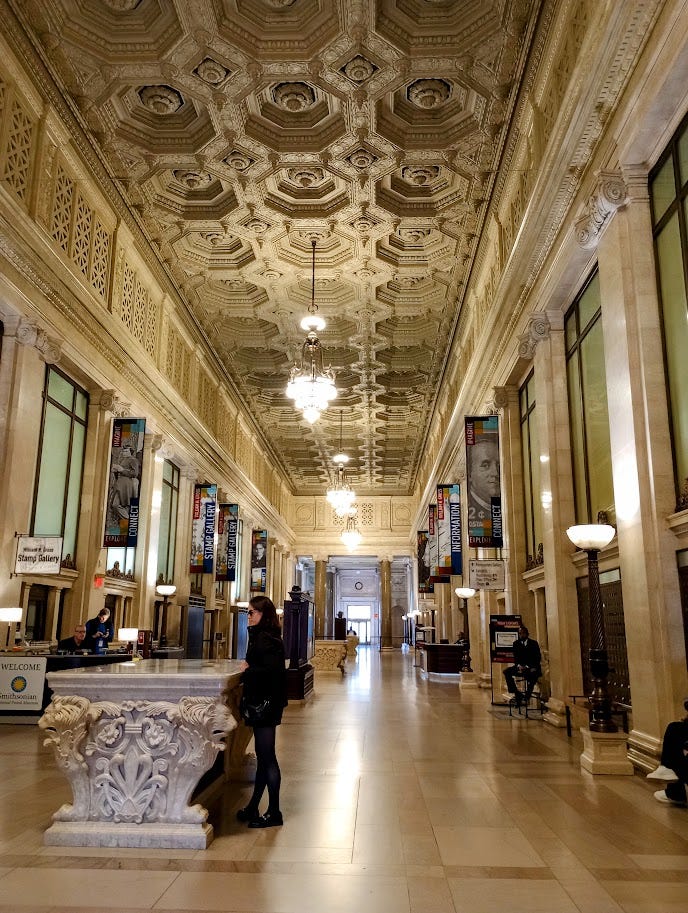
As we stood in this extraordinary lobby, I turned to my son, Hoosen, Jr. “I want to see the upside-down plane stamp.”
“Oh, they have it,” he assured his old mum.
“What's that?” said Hoosen, his dad.
“The most valuable stamp in the world”, I said. “The printers screwed up and put the image of a plane upside down.”
But we didn’t go immediately in search of the expensive stamp blooper, because the exhibition really starts, sort of, downstairs, in the basement. So that’s where we headed first.
Symbolic Buildings
Of course, most Post Office buildings were never as grand as the amazing building in which we stood, although some certainly tried. Check out this selection of post offices, from pretty amazing to truly tragic:
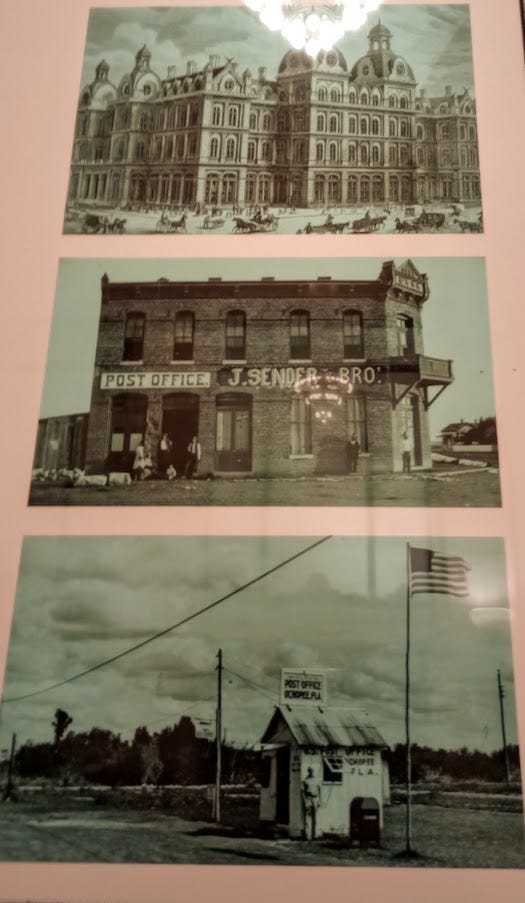
“Post offices have always been a place where people can connect with their government,” said the info panel that accompanied this set of photos. “People come to this building to buy stamps, mail letters, pick up tax forms, and apply for passports. They once even did their banking here!” Well, that sounds convenient. And more socially satisfying than banking on a smartphone app.
But this next line on the info panel gave me a thought I’ve been thinking about ever since that day: “Like many post offices, this building [meaning the one in which I was standing] was designed to reflect the presence and stature of the Federal [UK: national] government.”
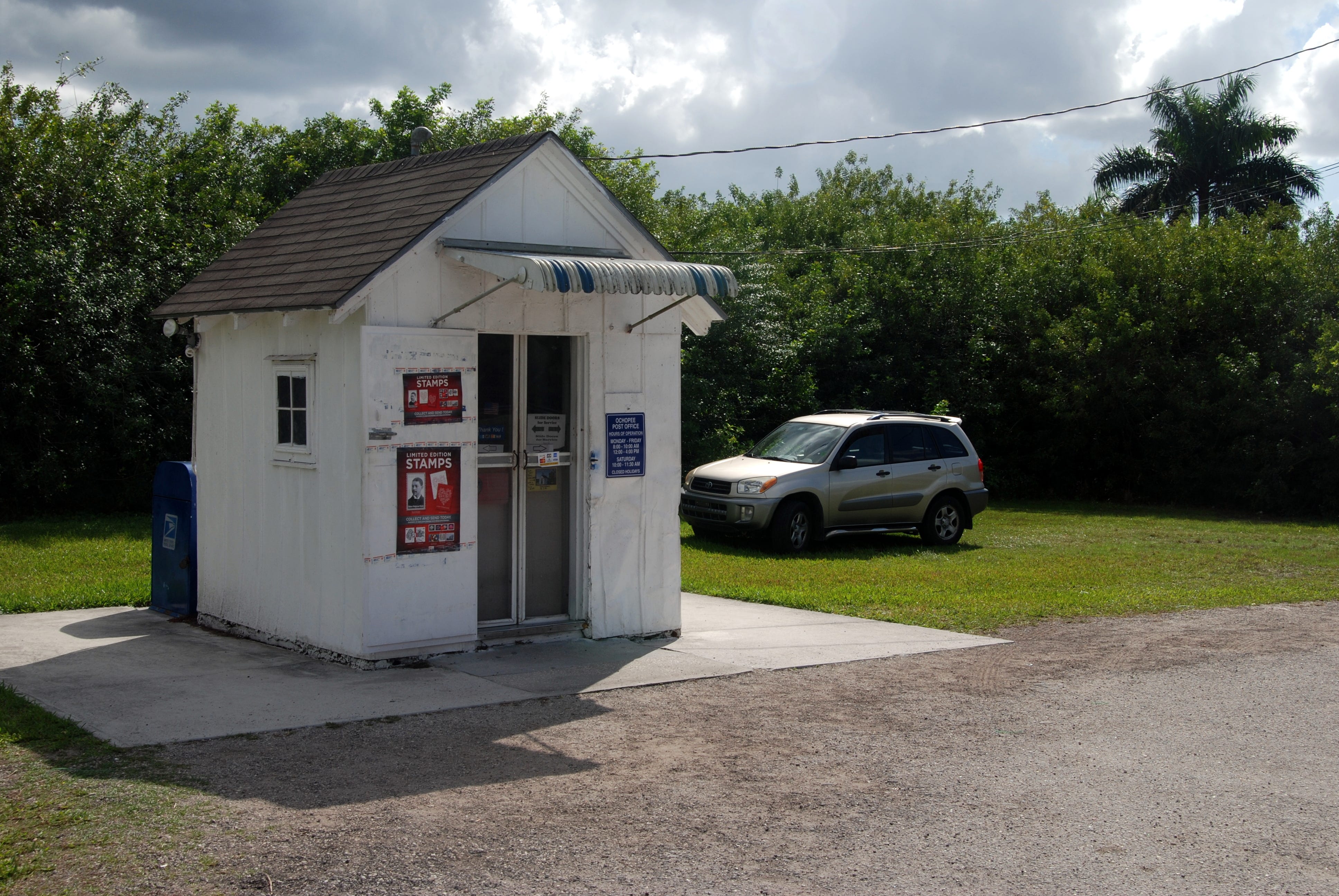
I looked at the post office in 19th century Chicago (at top of photo above) and contrasted it with the shabby little shed that served as the local post office in Ochopee, Florida. I thought, yeah, that makes sense as a measure of the relative esteem (or lack thereof) in which the federal government was held in each place.
But then I thought of Florida House, and the grand building that the people of the State of Florida in 1973 had established in Washington DC, their nation’s capital. Maybe the relationship between, say, Florida, and the federal government was not such a simple story as I had assumed.
In fact, I was wrong to make assumptions: Each post office in the photos above reflected the size and perhaps wealth of the place it served.
Chicago had loads of money, but most of it wasn’t to be found in city slums in the late 19th century, when the city was booming with immigrants from southern and eastern Europe, like Italy and Poland. Those immigrants were all sending letters home, and so the Chicago post office saw a massive uptick in mail. And I should add, this post office in Chicago was a great statement of civic pride.
Meanwhile, in 1930, Ochopee, Florida, was a small backwater hamlet. Still is, in fact: Much of the land is now part of the preserved area of the Everglades swamp. The tiny post office building (see below) is still there, and it’s still the post office, smallest in America. You can buy stamps here. How cool is that!
Post Office Blues
No matter how modest or positively ramshackle was a local Post Office, the Museum had pointed out, it was a place that represented the presence of the federal government.
Right now, we might be thinking of Americans who resent or even despise the federal government. To most Americans, though, regardless of their politics, a post office is just the Post Office, and they continue to use its services, usually while grumbling. Why? At time of writing, it’s still a heck of a lot cheaper than shipping via private companies if you’re a private individual or a small business.
The Post Office is not a profit-driven enterprise (not yet) but a public service. People grumble when the post office line is long, but I suspect —as I have sometimes remarked to fellow USPS customers in line—they would also grumble about wasted taxpayer dollars if they walked in and saw no queue, just two extra desk clerks sitting idle but ready to serve them. And I’ve had rotten experiences with UPS and FedEx, so it’s not fair to forget to make real comparisons, not just imagined ones. This has, I must report, given my fellow line-dwellers pause. Or at least ended our conversation. I have that effect on people. This is why historians aren’t invited to parties.
It’s hard to remember that there was a time when the Post Office wasn’t the butt of American jokes. But there was such a time. For much of its history, the Post Office was a symbol of American pride, dating back to colonial times.
Before we pop back to the 18th century, let’s start with a quick jog through the more recent history of the Post Office, the time of its greatest prestige, and its high-tech innovations. High-tech innovations are not something we generally associate with the Post Office—but maybe we should.
An Encounter with Ben Franklin


Wait. Didn't I just tell you we were starting our tour of the Post Office Museum in modern times? NOT the 1700s? What’s with Ben Franklin?
OK, so, unexpectedly, on my way to the loo, I bumped into Ben Franklin. He was, inconveniently, blocking the entrance to the restrooms.
“Oh, blimey,” I said, “Ben, what are you doing here?”
“Just staking my claim as founder of the Post Office,” he said. “Read the plaque.”
Here’s what it says:
BENJAMIN FRANKLIN
PRINTER- JOURNALIST
DIPLOMAT -STATESMAN
PHILOSOPHER AND FATHER
OF THE POSTAL SERVICE OF THE UNITED STATES
BORN BOSTON, MASSACHUSETTS
JANUARY 17, 1706
DIED PHILADELPHIA PENNSYLVANIA
APRIL 17, 1790
POSTMASTER GENERAL
FOR COLONIAL NORTH AMERICA
UNDER THE BRITISH CROWN
 1755-1774
Annette: I’m surprised you didn’t include scientist, inventor . . .
Ben: Eh, not enough room on the plaque.
Annette (continues) . . . ruthlessly successful publisher of evangelical tracts and books . . .
To read more about Ben Franklin as successful publisher of evangelical stuff he didn’t actually believe, click this link to the relevant bit in this paid post on business-minded evangelist George Whitefield:

Ben: Being an evangelical publisher, much less a ruthless one, doesn’t fit with my image.
Annette (continuing in same vein): . . . Abandoner of wife, expat playboy in London, slaveowner, collector of checks from Georgia to represent the colony in London while actually spending most of his time shopping and partying . . .
Ben: Shhhhh . . . Stop it.
A master of image management, that was old Ben Franklin. Can’t help liking him, though. However grifty he was, he was at least a self-made man, not born on a slave-staffed plantation with a silver spoon shoved in his mouth. He worked hard to buy his own slaves to do all the work for him. Ahem.
As royally-appointed Postmaster-General, Benjamin Franklin improved the colonial postal service, by reforming its accounting system, and introducing a night shift, turning the colonial Post Office into a 24-hour operation, to speed up processing and delivery.
But Ben belonged to the colonial era, and that wasn’t where the Museum insisted I start. It gave me choices. Not always a good thing.
Moving the Mail
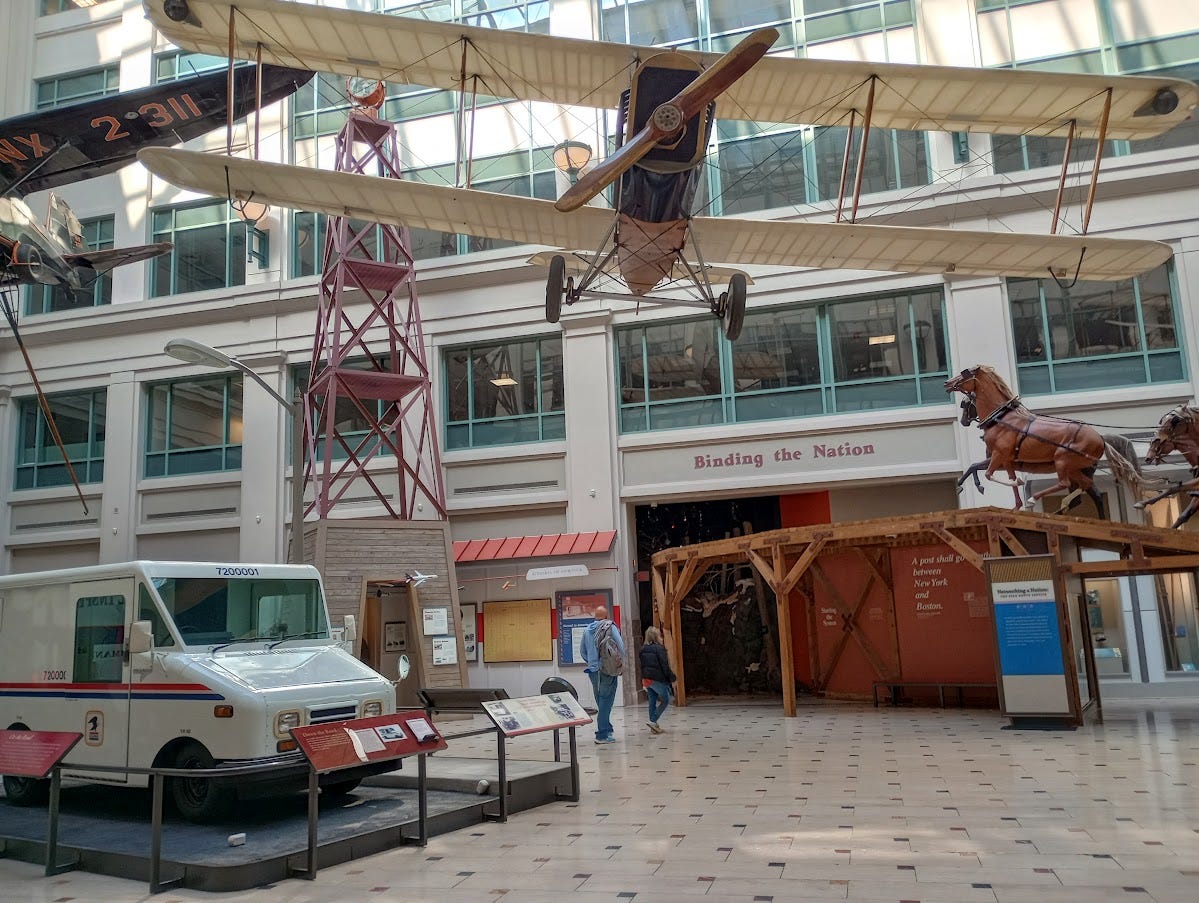
Typically, walking into a museum is information overload time: So many pretty shiny things calling our names, and it’s often not clear at all why they are there.
The basement of the US National Postal Museum (in photo above) is the main area of Museum exhibits, and as I descended down the escalator and scanned the view in front of me, I had that familiar feeling of confusion and disorientation.
I saw (see photo above) three very old planes, a stagecoach pulled by life-size fake horses, a dark hole in the wall beneath the words Binding the Nation, and . . . Yay! A typical modern mail delivery van! That van made the most sense. What was with all the other transportation hardware, though?
When I think about it, the history of the US Postal Service is really the history of transportation. It’s about our precious letters, greetings cards, and packages going on journeys in planes, trains, and automobiles, like unescorted minors on planes. The surprise is not that mail doesn’t always arrive as planned, but that it so very, very rarely goes completely astray.
Annette’s Aside: A salute here to the US Post Office and UK Royal Mail from back in the mid-80s, before things started to go badly wrong.
In 1986, I wanted to send a letter from California to an actor named Michael Craze in England, asking him for an interview for my Doctor Who newsletter. He had appeared as a series regular twenty years earlier, but most of his episodes (with Patrick Troughton, Who fans) had been lost. Only problem: I had no address for him. I had learned through the Doctor Who actors’ network that he was on an extended, um, rest from acting, and was working at a pub in Dereham, Norfolk.
In desperation, I wrote to Craze at “One of the pubs, Dereham, Norfolk.” It reached him, and very quickly. He replied, and we set up a meeting in Dereham.


The interview worked out not just for me and Christy Keith, my California friend and newsletter co-editor, but for Michael Craze. He, it turned out, was desperate to be recognized by fans in America, where Doctor Who was enjoying unexpected popularity on PBS (public television). Specifically, he longed for all-expenses paid invites to American Doctor Who conventions, and asked us to help. I’m happy to say he got those invitations, and was a popular invitee (despite all those lost episodes) for the rest of his life.
I’m also happy to have had a hand in that, but it all came down to two efficient national Postal Services, including the USPS not simply returning my letter as improperly addressed, and local Royal Mail and Post Office staff in Dereham caring enough to actually think it through and direct my letter to reach its intended recipient.
Michael Craze died from a heart attack in 1998, aged only 56. According to his brother Peter, quoted in Wikipedia, he spent much of his later years appearing at Doctor Who conventions. Caring and professional post office workers made that happen. Sure, these days, I could just Google, but that’s a pretty bloodless process that excludes most people from this story. Plus, honestly, I don’t know that it’s wise to make it so easy to contact people in the public eye. At least I had to work at it, back in 1986.
High-tech transportation and communications really are a large part of what the Post Office Museum in Washington, DC is about. So is technological innovation. No, seriously, I’ll show you.
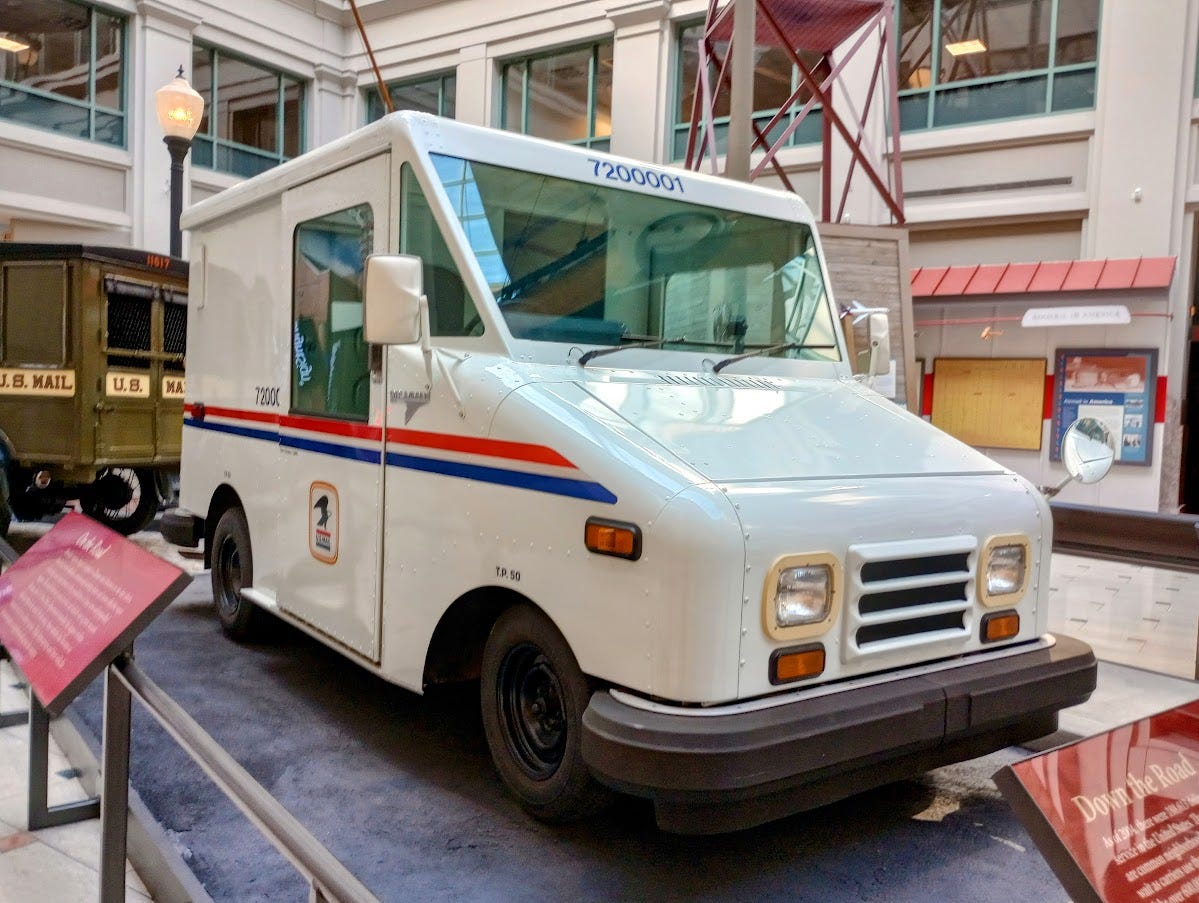
I started by taking a look at the good old Post Office delivery van, an attractively familiar sight. It looks exactly like it did when I came to America in the early 80s. Oh, no, wait, memory playing tricks: The Post Office van, as we know it, was introduced in 1986, the same year I wrote to Michael Craze (above). So what were mail carriers using before that? I couldn’t remember.
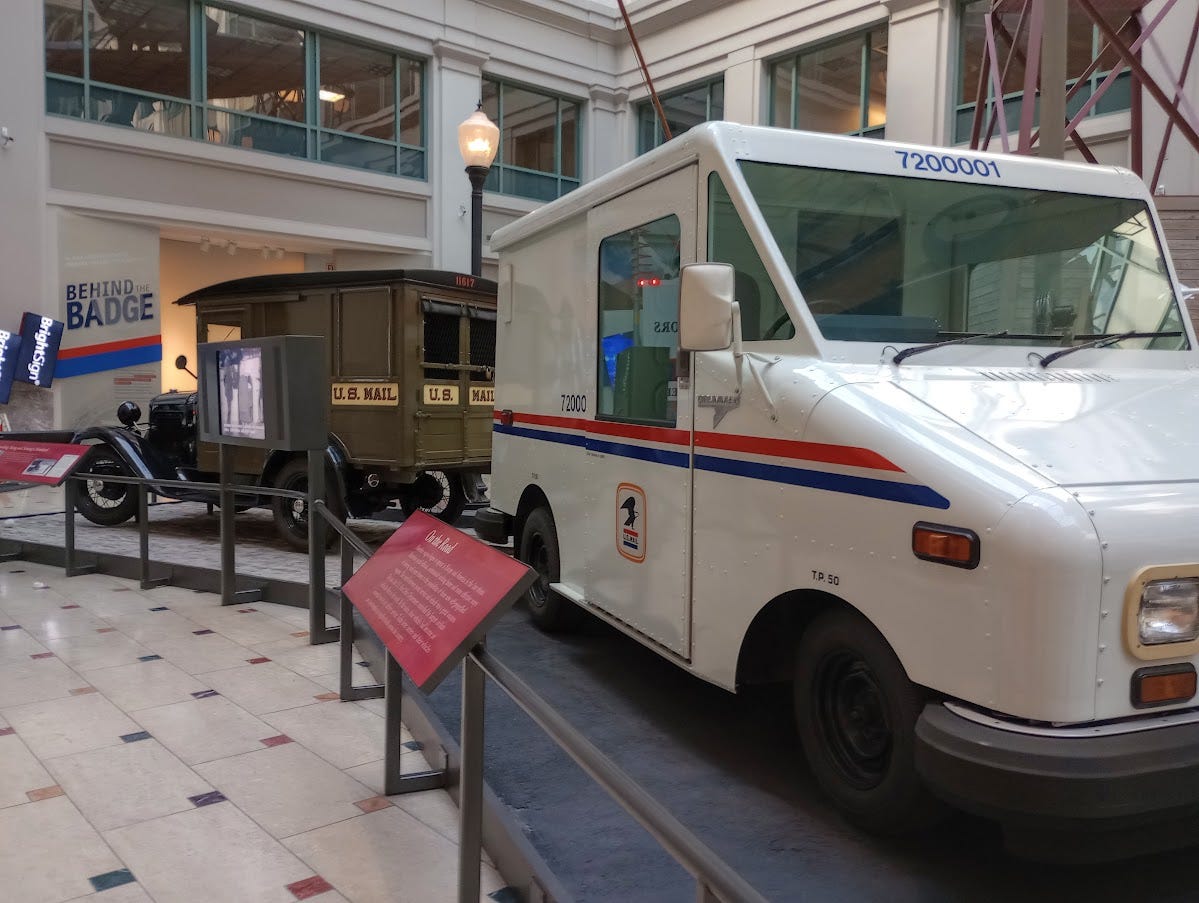
I forgot to photograph an info panel that would have explained earlier mail vans (sorry), but it’s not hard to guess that motorized Post Office vans were originally an innovation of the early 20th century. Note the photo above: The van behind the familiar modern one has a very 1920s look.
But I was surprised to learn that, until the 1950s, American mail carriers didn’t drive their own vans. A driver dropped off a mailman with his bag of mail, and picked him up again for the next round.
Realizing how inefficient this was, Team Post Office made a big decision after World War II, during which many strides in efficiency had been made under pressure of war, like Eisenhower figuring out that the US needed a freeway system like Germany’s, in case of invasion.
The Post Office now decided to put mailmen behind the wheels of their own mailvans. They needed a truck that was lightweight, nifty, and tough, and so they tested out three promising designs. One design in particular seemed very practical, cheap to run, and looked cool: The small, light Mailster. How cute is this?
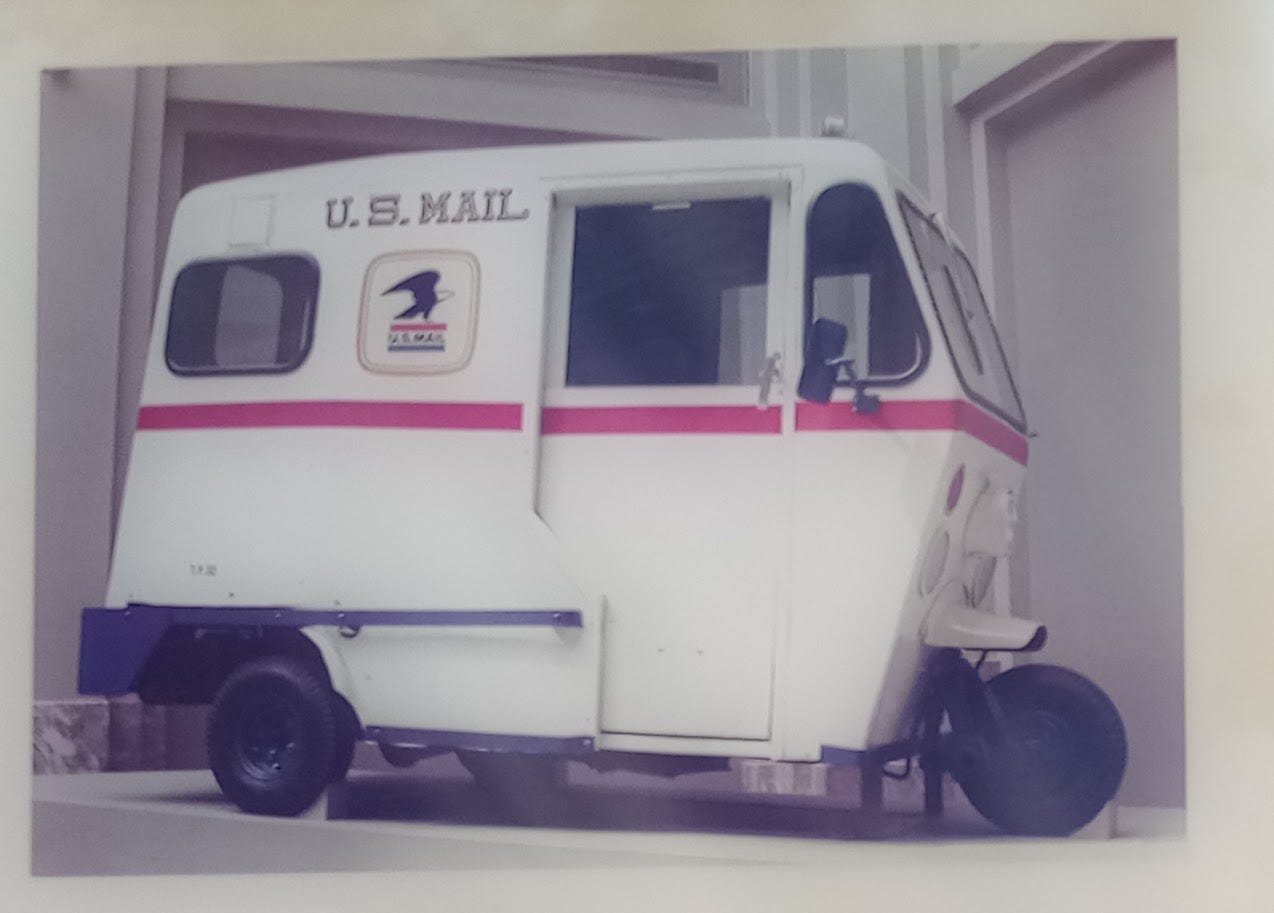
Sadly, during its testing phase, the Mailster didn’t run well (or at all) on uneven ground, or in bad weather. Having only three wheels didn’t help. Brit readers (and Mr. Bean fans) are familiar with the odd three-wheeled passenger car known as the Robin Reliant: You will not be surprised by the Mailster’s flaws. When traveling at more than 25 mph, or if caught in a gust of wind, the Mailster simply fell over.
One mailman reported that "The body is flimsy. They are easily broken into. They attract children like a play toy." Another said a large dog tipped over his Mailster, which must have been the final humiliation.
Cute idea, the Mailster. But you won’t be surprised that the 1950s Post Office, after testing it, opted instead for the sturdy Jeep, proven on WWII battlefields. Notice how they didn’t waste a lot of money producing a fleet of innovative vehicless without amply testing it on the road first. I’m thinking of at least one auto manufacturer who might have learned from that.
The Jeep remained the Post Office van norm for the next thirty years. It was the mail truck I had forgotten until now. In 1986, came the arrival of the boxy truck we know so well (with right hand drive so letter carriers can pop mail into mailboxes on the street), which now looks stuck in time.
What a surprise it had been to learn that the postal van has a dynamic history of change in the 20th century. But what brought that change abruptly to a halt in the 80s, I wondered? Why is the USPS van frozen in time? Shouldn’t it be electric by now?
Heavens, Britain had electric milk delivery vans (called milk floats) when I was a kid in the early 70s. Indeed, by 1967, Britain was claiming to have more electric vehicles on the road than any other nation, and almost all were milk floats. I would make a quick call to Elon Musk to ask if he knows about this, but I would probably get charged $1.5 million for ten minutes of his time.
In fact, there is a new USPS truck design. And it’s electric. It even has air conditioning, which makes it very popular among mail carriers in hot places like the Deep South: Them not having heat exhaustion is also good for efficiency.
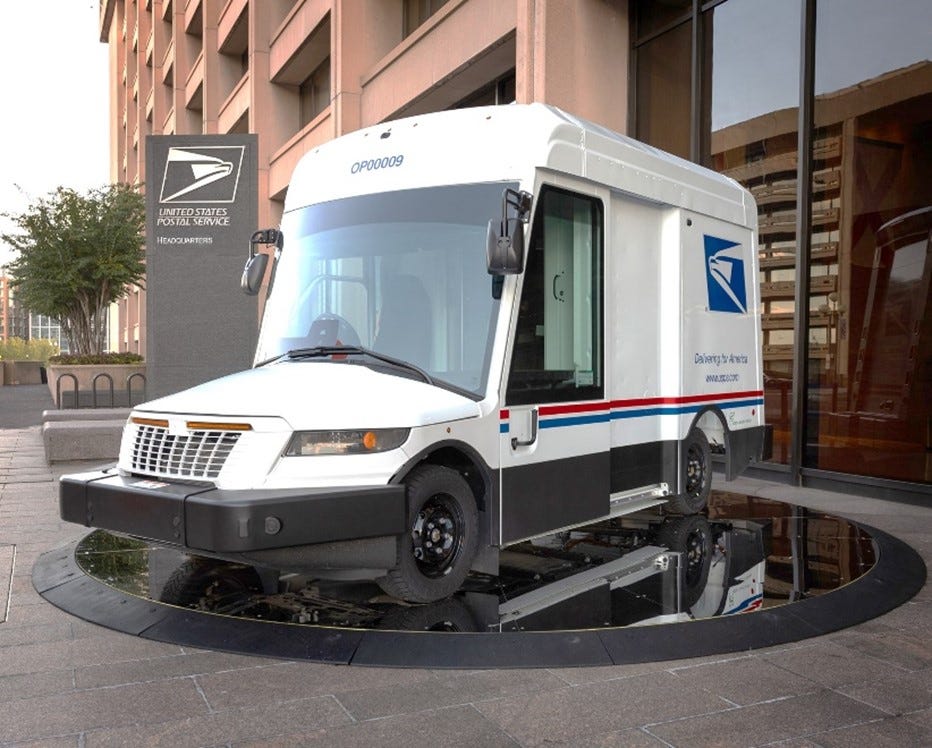
Production of the Oshkosh Next Generation Delivery Vehicles, or Oshkosh NDGV’s as they’re awkwardly known, began in 2023. The first NGDVs debuted in Augusta, Georgia, in 2024, a place where mail carriers definitely were thrilled to have air conditioning. The USPS then announced it would be investing $9.6 billion in these American-made vehicles as they rolled them out in the next few years. But that was in 2024.
A lot has happened since then, and since the contract to build NGDVs was awarded, in 2021, to a company named Oshkosh Defense, in Oshkosh, Wisconsin. Once the deal was done, Oshkosh Defense announced that the NGDVs would not, in fact, be made by union workers in Wisconsin, but at a new factory in South Carolina, by cheaper non-union workers. It’s a very complicated story, in which Democrats in Congress asked awkward questions of the makers (like, why did you build your factory in South Carolina after telling us you would build in Wisconsin?), and much more. I don’t have time or resources to pop on a journo hat and investigate this further.
Now, a question we all might ask, and my conservative readers might ask aloud, as I will ask on their behalf: Does it really make sense to fund Post Office van innovation, or the USPS itself, in the age of UPS and FedEx and email and texts? Hold that thought. Cuteness incoming.
Owney, Mail Dog
I missed the info panels about the airplanes in the main hall, but I think we can guess that airmail was a popular and efficient innovation from the get-go. Why did I miss those panels? I got distracted, partly because I was deeply conscious that this was not just a work visit but a family outing, in which I actually had to interact with my family, and partly because I was distracted by this little fella:
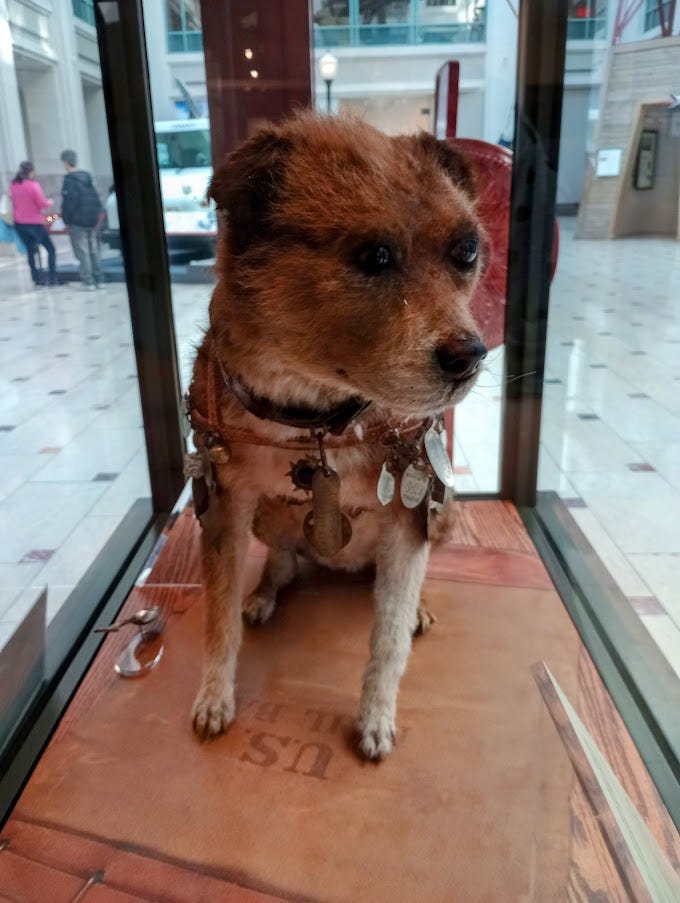
Don’t worry, Owney isn’t permanently crated at the museum. Actually, ok, yes, he is, and he’s crated in a glass case, because he’s extremely dead. Deceased since 1897, in fact.
Owney’s master, a mail worker, brought him to work in Albany, NY. When Owney’s owner quit, Owney (who was very popular) stayed behind. He would follow mailbags right onto trains, and Post Office workers looked after him on his travels throughout the continent. Said the Washington Post in 1895: “Owney acknowledges no master save about 100,000 United States postal clerks throughout the length and breadth of this land.” Awww . . .
On his harness, Owney collected souvenir tags from each of many USPS sorting depots, until the poor little soul must have been groaning under the weight of them, as I pointed out to Hoosen, Jr.:
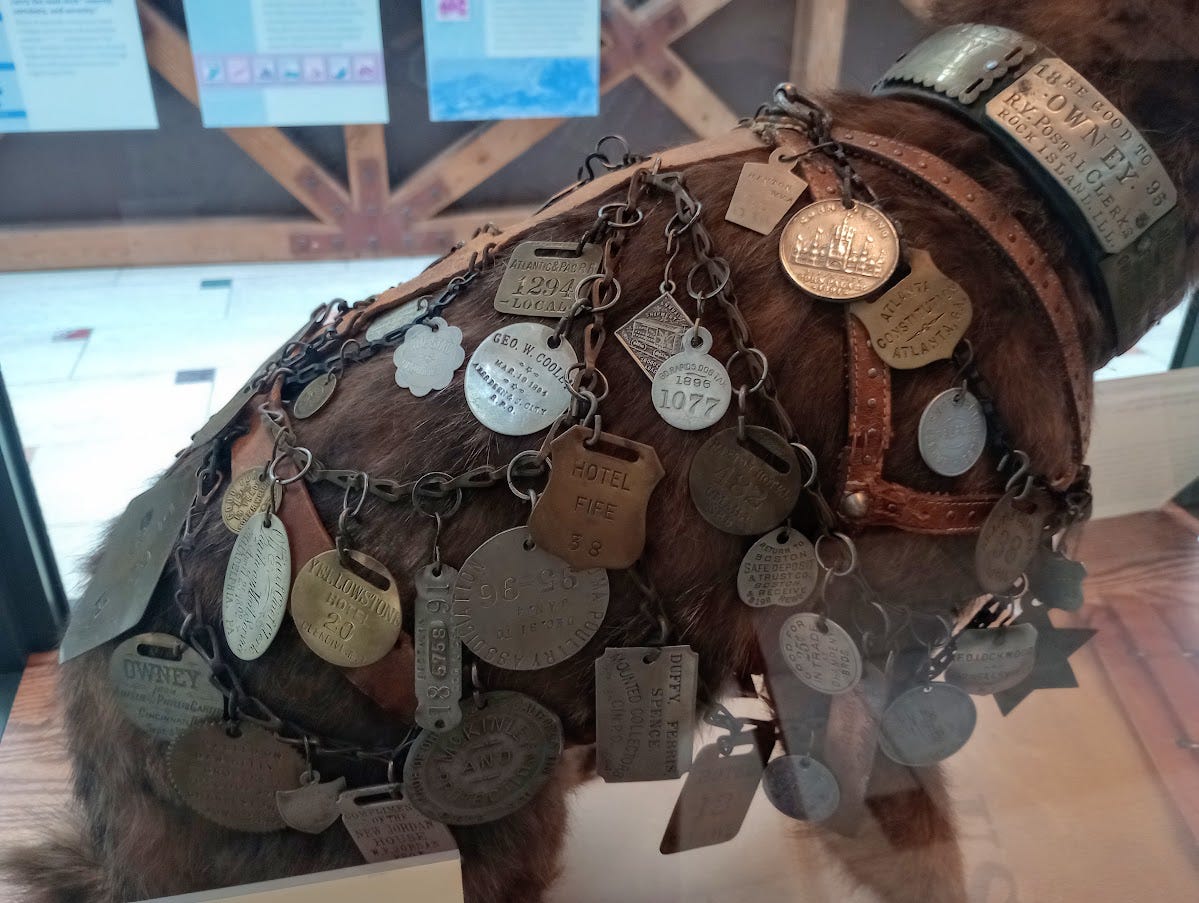
I’m a soft touch for cute little dogs. But this small Owney exhibit was also very moving because it provided a human (and doggy) touch to Post Office history in an exhibition that was so far mostly about gadgets. Notice how the postal clerks at Rock Island, Illinois, added a plaque to Owney’s collar in 1895, asking everyone to “Be Good to Owney.” Awwww, I say again, with an extra “w”.
I did wonder if all those little love charms finally led Owney to collapse and die under the sheer weight, but, as I looked at Owney, I considered this:
Owney’s tags reminded mail workers who glanced over them that they were part of something bigger than their local Post Office train depot. They were part of a national service, and an enormous nation, beyond imagination in its size, but one which the Post Office helped knit together.
Owney also helped connect the far-flung staff to each other, even as they connected Americans to each other, and to the world. No wonder so many Post Office workers were keen to add another medallion, theirs, to poor Owney’s burden.
How loved was Owney? When he was promoted to the Great Post Office in the Sky, mail clerks across America chipped in to have him stuffed. I know many people today are squeamish about taxidermy, but think about it: Thanks to a skilled taxidermist, we know exactly what Owney looked like, more than a century and a quarter after he escorted his last trainload of mail.
Train Mail on the Mail Train


I’m sorry to say this, but, as a Brit raised in the 70s, seeing a mail train makes me think immediately of the strangely intriguing Ronnie Biggs, Buster Edwards, and all who committed the notorious Great Train Robbery of 1963, which netted £2.61 million (a LOT of money now), ruined the driver’s life (he was brutally assaulted), and spawned decades of fascination among the British public. My dad, no fan of crime or criminals, often said hello to a reformed Buster Edwards when he ran a flower stall in London after he was released in 1975, following nine years inside. Sadly, Buster’s reformation may not have lasted: When he died, he was being investigated for possible involvement in fraud.
But I digress. Back to the US National Postal Museum, where I pulled myself together, and tried to concentrate instead on how hard it must have been for postal workers to sort mail on a moving train. Even just walking around a moving train today is a test of good balance.
But how brilliant was it of the US Postal Service to take full advantage of the US train network in its heyday, to speed the mail ever faster between sender and recipient. And as we’ll see, an ever-expanding and more literate letter-writing American population required more and more innovation in mail delivery.
So that’s what we wandered into next: An exhibit on The Expansion of the Post Office and Its Tech, although this part of the Museum wasn’t actually called that. I just made that up, because I missed the name of this exhibit, if it had one. It starts the story of the Post Office from the beginning of the modern USPS, in the late 18th century.
The Unexpected Priority For the Mail
With all due respect to Benjamin Franklin, who served as postmaster to the British colonies, the official United States Postal Service dates only to 1792, by which time Ben had been dead for two years.
I was not surprised to learn that mail in the early days of the USPS was expensive, but I was surprised to learn why: Charges for private letters were intended to subsidize the cost of mailing newspapers.
See, it was newspapers, the most efficient vehicle for the spread of news, information, and yes, opinion, that was the priority of the Post Office of the new American nation. The United States had worked for and won independence by having serious discussions among far-flung people, not only in handwritten letters, but more publicly, in print. No phones, no robocalls, no group texts, no mass emails, just in-person meetings, letters and, especially, newspapers to bring people together and come to agreements on how to proceed.
I find this thought fascinating in light of my last piece on the impact of public opinion:

Sorted
As early as 1800, the US Post Office designated certain large post offices as hubs. Mail to each region was processed in these big buildings and then sent on to local areas. The same system, the Museum says, is again in use today. I’m not sure when “today” is, because that kind of remark in museums dates quickly now, but this does suggest that the hub system was abandoned for awhile, then resuscitated to meet new needs. It also tells us that the Post Office has long been keenly aware of its own history—as every institution and business should be. No point in reinventing the wheel.
Stamps!
Originally, a postmaster charged for the weight of a letter, but the sender didn’t have to pay the fee: Senders could pay all, part, or none of the cost of postage, with the difference being charged to the recipient. The addressee could refuse delivery of any letter, but this wasn’t a fast and efficient system, was it? Imagine trying to decide whether to accept each and every “postage due” letter addressed to you or a family member. Oy.
But lo! Now postage stamps were invented, offering flat rate shipping for most letters, and starting with a stamp bearing the face of the first US President, George Washington! No, no, that’s not him in the photo below. That’s Ben Franklin. The George Washington stamp is barely visible, and to the left of the photo.
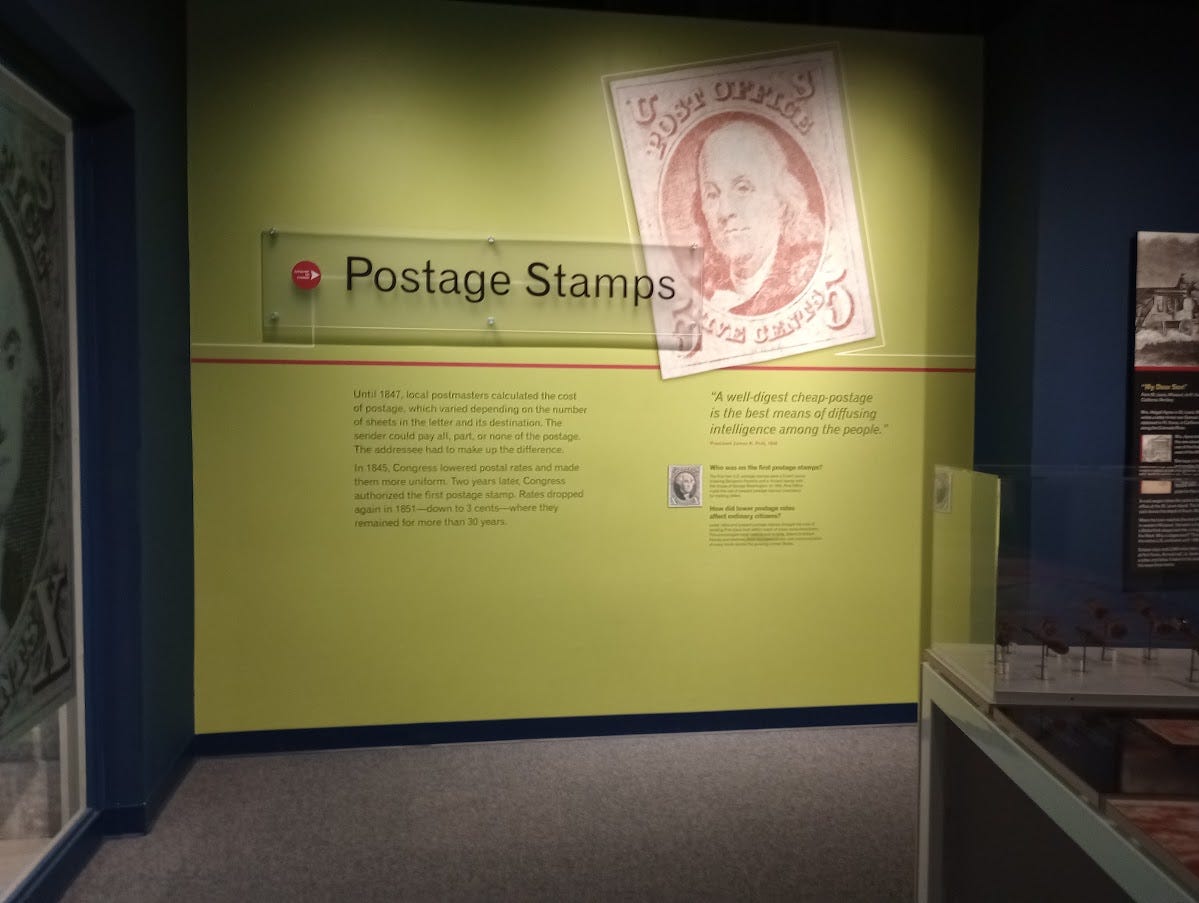
HANG ON A MINUTE. Postage stamps were not an American idea. They were invented in England by Rowland Hill, as Brits know. Was there any mention of this fact in this display on the first US stamps? Let me save you the trouble of looking: THERE WAS NOT.
I bristled on my countryfolks’ behalf. Brits have so few claims to fame these days, but surely the FIRST STAMP is one of them? That was the famous Penny Black, bearing Queen Victoria’s face, and NO indication of which country the stamp represented. Why? Because Brits invented postage stamps, so why, they grumbled, should we identify ourselves on the wretched things, eh? That was the thinking. Still is, even now.
Anyway, the US Post Office nicked the idea of postage stamps off Britain, introducing postage stamps in 1847, a good seven years after Britain did.
Oh, and I do have to mention the older, other kind of British stamps, the originals. These were embossed bits of paper representing another kind of tax, not postage. These, the Americans had objected to in 1763, but had never actually seen, since massive protests killed off the Stamp Tax before it could be implemented in the American colonies. Those tax stamps were basically the original stamps, the same as the later postage stamps: Embossed images stamped in rows onto a big sheet of paper, which was then cut into individual “stamps”. These were glued to a document to indicate that duty had been paid.
I wrote in 2022 about 18th century tax stamps from England and the Stamp Act in America, just one of a searchable collection of almost 600 of fresh posts awaiting paid subscribers at the NBH website:

Mail Goes Wide
Postage stamps were just the beginning of modern Post Office innovation. In 1851, mail rates were deliberately dropped to 3 cents for a letter, which was cheap for most people. This change happened just as the US population was massively expanding in the far-flung West, following the California Gold Rush of 1849.
The goal of the USPS was not profit. It never was. It was intended as an essential service to the American people, as efficiently as possible transporting letters and (don’t forget!) published materials. Even now, you can send books using the cheap USPS Media Mail rate, which is much more affordable than sending them by normal parcel post. The goal was to spread educational materials. I’ve had private company workers claim in answer to my questions that they’re not “allowed” to offer media mail, which sounds very dubious to me. Much more likely is that for-profit corporations are unwilling to run a delivery service on which they make a loss, not a profit. But I digress.
Most people who moved West in the 19th century were determined to keep in touch with the folk “back east”, and so post office branches were dotted at Army bases along the westward trails. Soldiers were stationed there supposedly to defend Americans from Indian attack as they headed West with wagons to Oregon, Utah, and California. But it quickly became clear in the 1840s that Indians were not interested in attacking the wagon people: Offering the travelers goods and services, like comfy moccasins and help with river crossings, was much more appealing to Native peoples. Today, you may come across tribal travel plazas offering cheap fuel, tobacco, snacks, and, um, entertainment opportunities in mini-casinos.
So by the late 1840s, military bases like Fort Kearny, in modern-day Nebraska, had become travel plazas (UK motorway services) providing migrants with wagon repairs, meals, shops, and, yes, post offices.
These plazas were still run by the US Army, because civilian federal workers weren’t yet a thing, except in the Army and Navy, and at the Post Office. That situation changed when Army officers tired of babysitting Gold Rush migrants, and recommended civilians be hired to do this work.
Interested in Fort Kearny and its services, including the Post Office, to westward migrants in the mid-19th century?

I recall reading a diary by a California wagon migrant who was absolutely stunned to find a post office in the middle of the Great Plains, flag flying in front. We can imagine why that came as a surprise. But it was a point of pride for the Post Office to reach as many Americans as humanly possible.
Mail Goes Deep
Hard to imagine this now about America, that it was once a nation of countryside dwellers. But according to the US Postal Museum, “In 1860, fewer than 13 percent of Americans lived in urban areas and only nine cities could claim 50,000 or more residents. “
Things had changed dramatically by the end of the 19th century. By 1900, America was rapidly moving toward the mostly urban—rather than rural— nation it would finally become in the 1920s. By 1898, 30 percent of Americans already lived in cities. And all this presented the Post Office with another challenge:
Just as the Post Office was chasing the population moving West, it was dealing with a massive rise in the sheer volume of city mail needing delivered to millions of people now living in congested cities in the East and Midwest.
Mail Goes Deep and Wide
One growing challenge for the 19th century Post Office happened especially after the American Civil War (1861-65), when American industry took off. The issue was the rapid rise of large cities which couldn’t cope with the pace of change. Cities like New York and Chicago were inundated with almost 12 million immigrants between 1871 and 1900. Many immigrants were destined for work in America’s new factories in the cities, as well as headed to claim free land in the Midwest and the Great Plains, much of it thanks to the Homestead Act.
Immigrants were eligible for free land (confiscated from Plains Indian tribes) under the Homestead Act:

How big a problem was this? In 1889 alone, according to the Museum, over 87 million letters and cards were exchanged between Europe and America. That’s than twenty times more than before the Civil War. Wowzers!
And it wasn’t only immigrants who were writing lots of letters home about their new lives to family and friends in Europe (from the East and Midwest) and Asia (from the West). It was also native-born Americans, Black and white, who were spreading across America in pursuit of more opportunity, and writing letters home to family, and friends.
In the past, keeping in touch after a family member had emigrated to America had proven hard or even impossible. Now, in the 19th century, thanks to low letter rates and efficient delivery, mailing letters was easy and cheap. And the word—good and bad—about life in America spread.
I don’t want to exaggerate how new this long-distance communication was: One major reason British Americans turned to slavery starting in the late 17th century was that the supply of English indentured servants who had staffed American fields since 1607 was drying up, as letters from English people in America revealed that, far from being a land of milk and honey for most English people, Virginia was actually a bit crap, and the forced labor of indentured servitude a misery that was also often fatal. Plus you’re looking at a historian who has read more than 10,000 letters from America in the first half of the 1700s.
However, it’s safe to say that far more information was flowing back and forth across the Atlantic and the Pacific by the end of the 19th century.
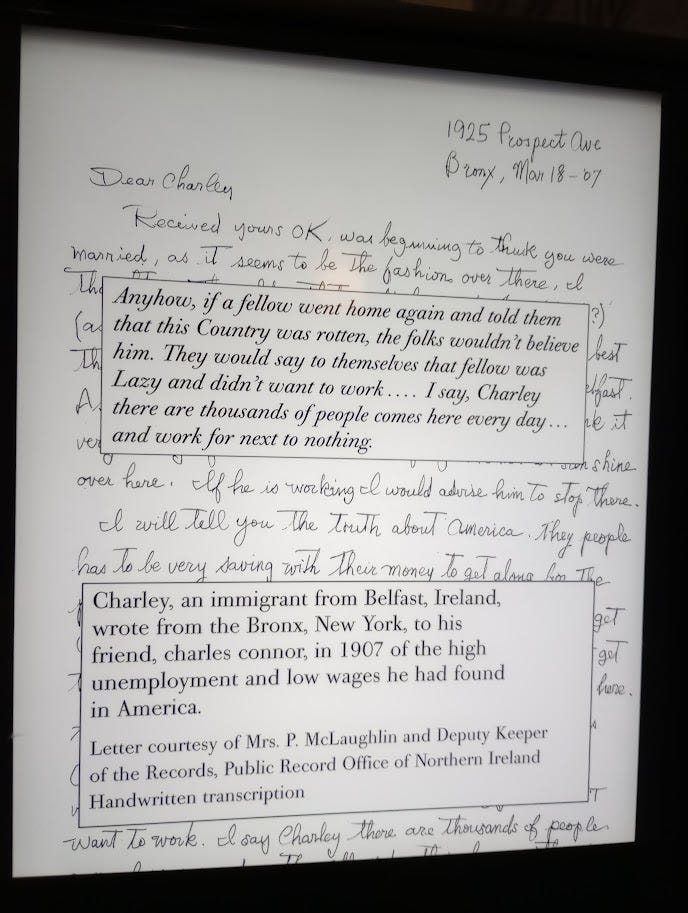
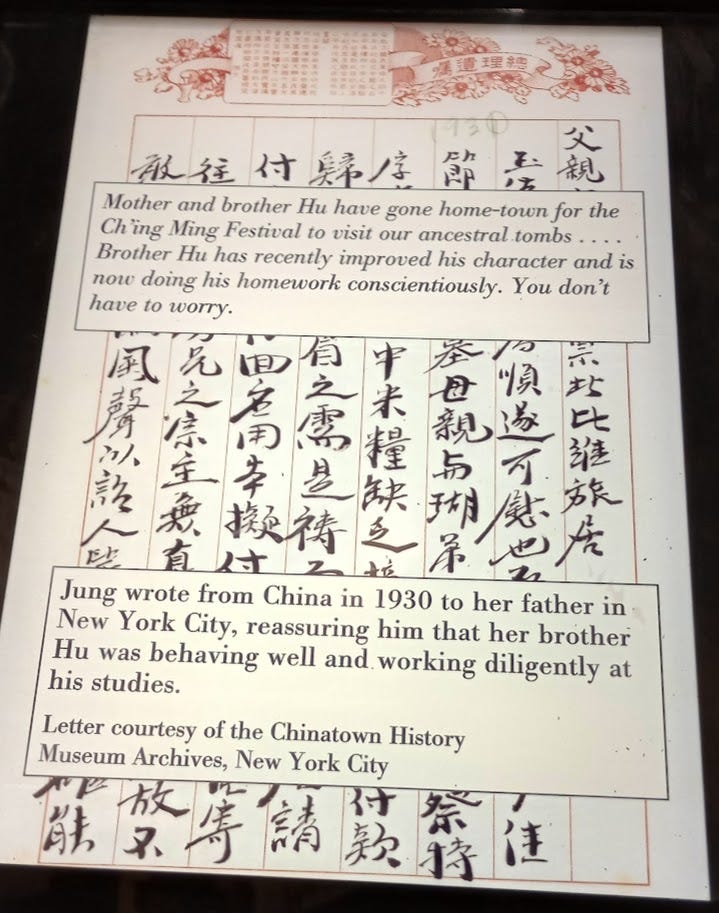
The Museum has a super display of letters from immigrants, most of whom have mixed responses to life in America.
A stereotypically blunt Irishman writes from America to Ireland in 1907:
Meanwhile, an equally stereotypical letter from China assures an emigrant Dad in America that his son is doing his homework:
So how did the US Postal Service cope with all this mail?
Quick answer: Innovation.
Home Delivery!
Hard to imagine that USPS didn’t deliver to people’s homes and street mailboxes until the Civil War, but it didn’t. I am fascinated by how home mail delivery came about in the United States, a nation so vast, you really don’t get it unless you drive across it at least once. Home postal delivery was available from larger post offices before the Civil War, but it wasn’t offered by the Post Office: it was a private for-profit service created by innovative entrepreneurs. Independent mailmen, think Deliveroo or Uber drivers (only independent not corporate), collected letters from a local post office and delivered them, charging each recipient a few cents for each letter. This was cheap per item, but the cost quickly added up when you got a bunch of mail delivered, so most people preferred to call in at their post office for their mail.
People picking up their own mail wasn’t ideal, either. During the Civil War, long lines formed at city post offices, as women and children queued for word from husbands and dads on Army service.
Joseph Briggs, an ordinary postal desk clerk, took note of the long wartime lines at his post office in Cleveland, Ohio. He suggested to his bosses that they start offering official and FREE home delivery. Notice that Mr. Briggs actually got the credit, which I bet he wouldn’t now in the golden age of credit-taking bosses! This experiment was a huge success, and official FREE Post Office delivery soon spread to all American cities. Cheers, Joe Briggs!
Still, don’t think this USPS delivery service was home mail delivery as we know it today. For one thing, there was no delivery—free or paid— in the countryside. For another, urban postal carriers didn’t just leave your mail at your home. That’s because there were no mailslots or even roadside mailboxes. A mailman had to knock on your door, wait for a reply, and hand over the mail to you. A mailman carried a whistle, and a door knocker, to alert homeowners to his presence as soon as possible, and without bruised knuckles.
Let’s just think about what a hassle that must have been for the mailmen, especially when nobody was home, and they had to keep carrying around that day’s mail. The Post Office figured out what a waste of time this process was. So, by 1916, every US home was required to have a letterbox.
But this wasn’t the only way in which the Post Office started speeding up mail delivery. Not by a long shot.
Speeding Things Along
I knew that massive horse-drawn traffic gridlock in mid-19th century London pushed the city more and more toward developing an incredible innovation: underground public transport. Note to modern city planners: These kinds of public transportation projects are most successful when they are absolutely necessary.
But I hadn’t thought of how late 19th century American traffic jams might have been partly the fault of the Post Office. The problem? Mail was often carried on horse-drawn wagons that got caught in gridlock, at a time when traffic lights hadn’t been invented, much less roundabouts.
It sounds like science fiction, but how about city mail being sent at super-high speeds through underground tubes? That happened in large American cities starting in the 1890s, and it was inspired by a system tried in London, beginning in 1863. Yes, the same technology once used by some British Co-Ops (see one in action at Beamish Museum, Brits) and still used by US drive-through banks. The only problem with pneumatic tubes, as the Brits discovered first, and the Americans discovered later, was that sometimes mail got stuck in them. This meant some bloke had to go underground and unclog the pneumatic tubes--and sometimes, the street had to be smashed up to get at the snarled mail. No fun.
Later, in 1906, Chicago successfully used underground railways just for mail, and the Brits soon copied this in London. Note the international flow of ideas!
But pneumatic and train tube systems didn’t allow for big unforeseen change. After World War II, as American neighborhoods changed (code for middle-class people and businesses moving to suburbs, while poor Americans were left behind), and as general mail volume increased, pneumatic tubes system became not only jammed, but obsolete.
A Little Bit Country
As city populations grew, Americans in rural areas noticed they weren’t always being treated fairly. The cost of mailing a letter was the same wherever you were, but there was no home delivery in the American countryside, which often meant a long, bumpy, and even muddy drive to get the mail from the nearest post office, with no discount for the inconvenience.
Rural Americans protested, and they had friends in Congress. By 1902, despite fears of some politicians that delivery in the countryside was too expensive, there was a lot of public support for it. Public opinion strikes again, thanks in part to cheap delivery of printed materials! So free delivery in rural areas was extended nationwide. Americans saw the Post Office as an essential service, not a business. Which is not to say that the Post Office had nothing to do with the success of businesses in the US economy. Ooh!
Mail Order!
Long, long before the dreaded A*****n, people figured out how to use the mail to benefit businesses and their retail customers, offering goods for sale over hundreds, even thousands of miles.
Here at Non-Boring History, we’ve seen examples of shopping by mail from colonial America and 19th century Britain, like this:

Online ordering really blossomed in America in the late 19th century, with the expansion of the Postal Service. Ordering stuff from big fat catalogs (later recycled for toilet paper) became a normal part of rural American life. The most famous catalog was sent out across America by Sears Roebuck, based in Chicago, which was practically in the middle of the country, and certainly a convenient hub for railroads—and mail. Sears Roebuck published its first mail-order catalog in 1887. Everything from seeds to houses could be bought from Sears—and was. Like I said, it was the A____n of its time.
Sears Roebuck and other mail-order retail businesses depended on the US Federal Government’s affordable Postal Service being careful and prompt, because a damaged or late package hurt business. The parcel post started around 1910, I read at the Museum, but how did Sears Roebuck manage between its first catalog of 1887 and the new parcel service in 1910? Hmm. Not clear. Probably paid more. What is clear is that parcels were now big business in America, and that the Post Office, a federal government service with cheap rates (especially for businesses), was making profits happen. Not to put too fine a point on it, but worth a think.
Post Offices Go Industrial
Around the time of the First World War, large post offices became mail factories: Machines canceled stamps. Mail was sorted onto conveyor belts and into large buckets, work done by Federal postal workers on a kind of assembly line. Mailing a letter by now was a thoroughly modern affair. The museum gives the example of an anonymous American WWI soldier mailing a postcard to his mum from the trenches in France, to assure her he’s not dead. The postcard goes through an efficient system from France to the rural area of Linwood, Maryland, using ships, trains, wagons, and now even automobiles. I think of my poorly-addressed letter from California reaching Michael Craze at “one of the pubs” in a small town in England in 1986, and I marvel.
And On It Goes
The last part of the Museum’s exhibit on recent USPS history, from the 1960s onward, didn’t interest me so much. ZIP codes, bar codes, automatic sorting, all the then-new tech became a bit, well, boring, to someone who lived through all this change. I hated those bar code thingies: I had to give up a lot of the already limited space on a postcard to accommodate them. They’re gone now. I’m relieved to note that we still have postcards, some of which I am mailing this week to paid subscribers (see below for details!)
And then, as we know, although the Post Office Museum ignores this, everything changed. Email largely replaced letters. Bills were more and more paid online. UPS, FedEx, and others took up package delivery, and the dreaded A****n, the 21st century’s Sears Roebuck, even launched its own delivery service, with vehicles and delivery people who don’t have time to stop and chat, or check on elderly people on their routes, or sometimes even go to the loo. The USPS was targeted by a growing drumbeat of criticism, much of it unfair, even as its funding was cut and pressures grew.
There’s something else the Museum doesn’t mention, but I will: The phrase “going postal” came from several incidents starting in 1986 in which a postal worker came armed to the workplace, and shot colleagues. AI results on Google simply call such workers “disgruntled”, a dismissive phrase that does little to explain why anyone, and especially postal workers, would commit murder on coworkers.
Could it be a coincidence that, even before the Internet, USPS had massive morale problems? Perhaps a bit of toxic management? There was a lot of toxic management emerging in the 80s, as I know all too well, having seen a journalist I knew well forced out of a job, and others, too many others, being tortured into quitting, or tortured until they were fired. If you know your Dickens, Fezziwig was removed, and Scrooge was now in charge. I don’t know if any historian has studied this phenomenon, or will, since historians now are battling for professional survival. Only the independently wealthy can afford to write real history outside of a university. History is a public service, like, well, the Post Office. It doesn’t make profit. And before you tell me about a historian who does, are you sure this person is a professional historian? And are they actually writing scholarly history? Think carefully before answering.
Stepping Backward
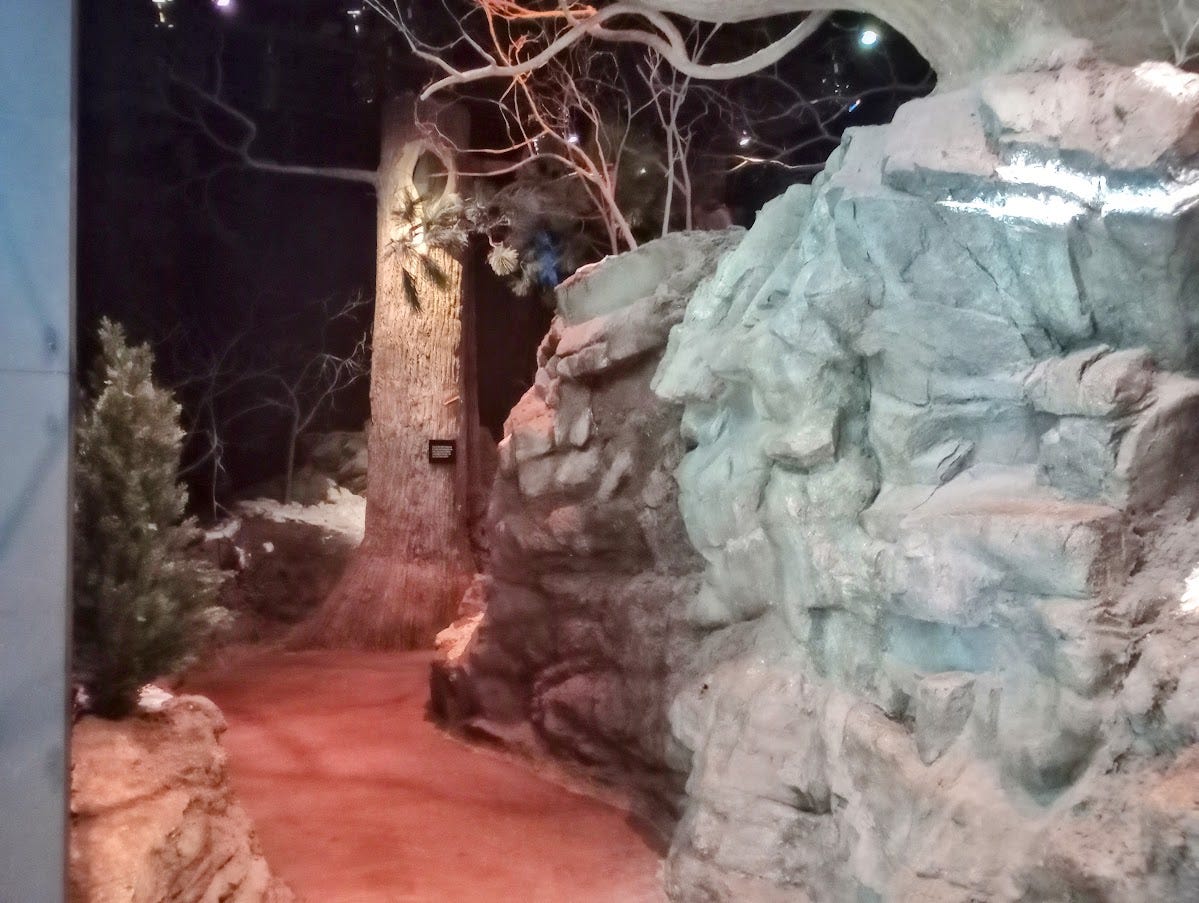
Why didn’t I start with the Museum’s story at the beginning, in colonial times? The National Postal Museum is designed so that you have free choice of routes, perhaps to avoid tourist gridlock in the busy season. So now I haven’t left enough space or time to go into the early days in detail. I did love the entrance to the remaining exhibit (photo above), which takes us to the very first mail carrier route, between New York and Boston, with a display that does feel like walking through the woods. I loved this, because one of my early NBH posts was on the solo journey in 1704 of widow Sarah Knight on the Old Post Road, which she recorded in a diary. At every tavern she stayed in, Knight booked a new male escort, who was often the post rider, aka the mailman.
I translated Sarah Kemble Knight’s amazing diary for you:


Thirty years before Sarah Knight’s 1704 road trip on the Post Road, back in 1673, there had not been an official road between New York and Boston: Any communications between these two very different English cities was done by ship. So English governor of New York (and New Jersey) Francis Lovelace sent riders along trails first developed by Indians (see? There was a road after all!), to make “blazes” or hatchet marks in trees to show the route.
The Old Post Road that Lovelace ordered is still there: It’s roughly followed by US Route 1, and in some places, the actual Old Post Road runs alongside it as a trail. Or so I’m told. Mailmen on horses collected and delivered mail at taverns (basically hotels, complete with accommodation, bars, restaurants, and even meeting rooms), which is why Sarah Knight was assured of meeting with a mailman every day to escort her safely on her way to her next accommodation.
This post is waaay longer than I planned. So one last thing before I go, because it really struck me, and it’s important.
Remember I said how the first United States post office prioritized cheap mail for newspapers, to allow the spread of news and opinion? After all, public opinion based on news and print discussion did much to make American independence from Britain possible. Well, this theme is picked up in this part of the Museum, in an undated essay by journalist Nat Hentoff, who died in 2017. He was a man who was hard to pin down on the political spectrum, which made him a superb journo.
Hentoff noted:
“Rufus Putnam, a [military leader] in the Revolutionary War, said, "The knowledge diffused among the people by newspapers, by correspondence between friends" was crucial to the future of the nation. "Nothing can be more fatal to a republican government than ignorance among its citizens."
While mail had long been subject to being opened by censors in England, and inspected for signs of disloyalty to the King, Hentoff wrote, mail-opening censors had never been a thing in America, where freedom of expression was considered vital. “From the beginning, by and large, the US. mails have been free of eyes other than our own and those of the sender,” he wrote.
“By and large” suggests that, yes, there have been times of censorship, I imagine the Civil War, both World Wars, and perhaps other times, but Hentoff doesn’t explain. Still, his message, that mail privacy has been the norm, is clear.
But that was before email and Google and online media, none of which are private at all. So is the mail obsolete as a means for the spread of information in the age of the Internet? We might think so. Or maybe it’s the last line of defense against censorship and propaganda. I don’t want to sound alarmist, but given that online platforms and even their payment processors for writers started to get odd ideas about what should be censored in the last few years (I mean, when J.K. Rowling has been called a Nazi, we’re in a very strange place, no matter how you feel about her views on gender). I’ve been very grateful to Substack: I’m truly not radical, I try not to get political, and yet I have wondered in the past few years how long it would be before every online writer was cancelled. If Substack vanished (no sign of that so far, but still), then how would I or any writer reach you? Every time stamp prices go up, I worry. Cheap, affordable, uncensored mail seems like a good idea again.
I read, on the walls of the museum, near Ben Franklin and the loos, this praise for the Post Office:
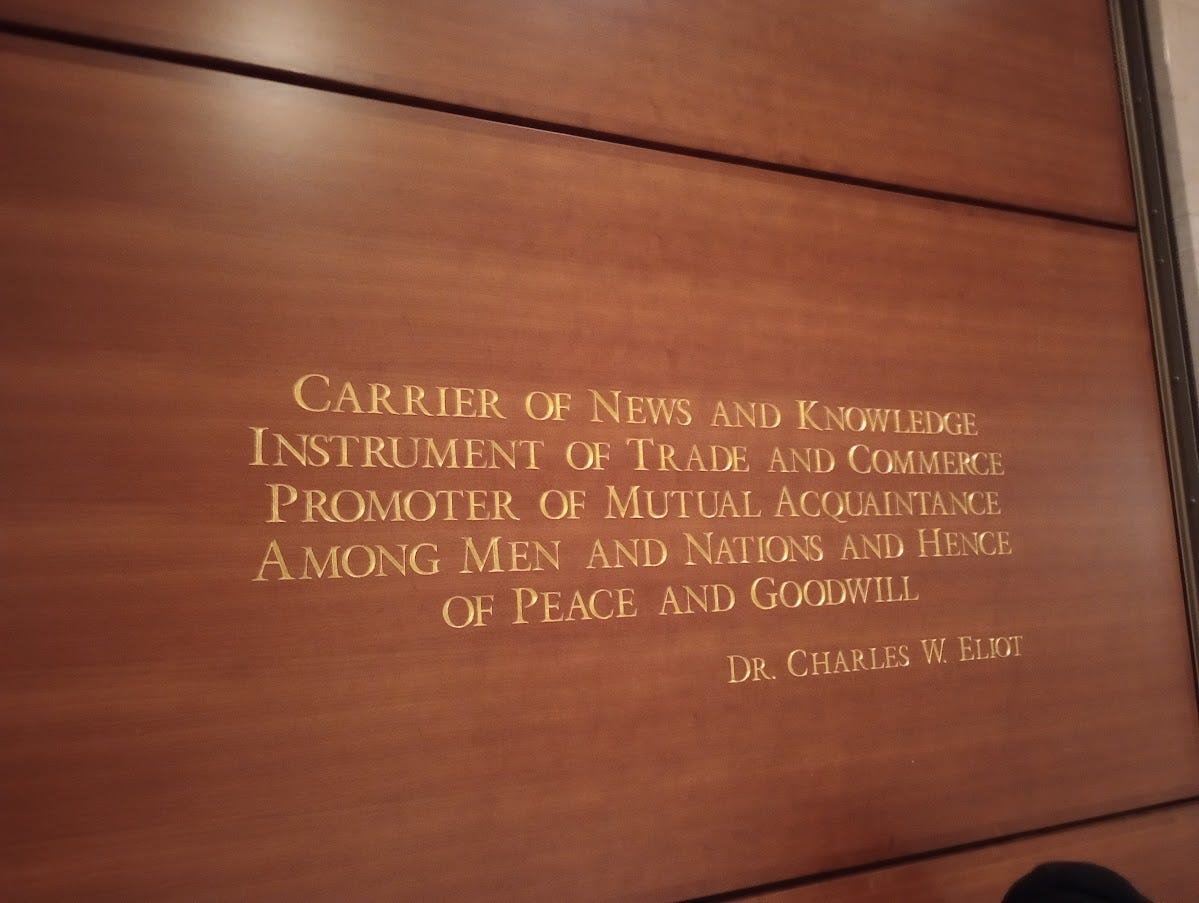
I wonder if we can say such things quite so confidently of the Internet?
P.S.
Inverted Jenny
I can’t end without telling you that, yes, we saw the upside-down plane stamp. Unfortunately, it was dark in that part of the museum, a display all about postage stamps, and so my photo of an actual block of the stamps kinda sucked. Here it is anyway, along with a photo of the entire display:


What fascinated me was learning that the stamp collector who bought the sheet of mucked-up stamps back in 1918 was a bit, well, grifty. Not just some stamp-obsessed nerd, but a bloke who sensed he could make a quick buck. He figured that the first day of issue for a two-color stamp was when he was most likely to find misprinted stamps for sale. Since the Post Office was actually very professional, this would be an extremely rare find. It did happen though, so the collector bought a sheet of 100 stamps, and sold the entire sheet to a stamp dealer. He made a fortune, $15,000 to be exact. Later, the sheet was broken up (you see a set of just four of them above). They’re now worth up to $2 million. Each. Yeah, I know, right?
An amusing bit of info in the display relayed the fates of some of the individual Inverted Jenny stamps: One was dropped on the floor in the 1980s by a careless collector, whose maid promptly vacuumed it up. It was damaged, but not destroyed. Actually, the text blames the maid, but c’mon. What was it doing on the floor? Puhleeze.
And the Brits Take a Bow
What a relief to find Britain, the Penny Black, and British stamp inventor Rowland Hill honored in this, the last exhibit we visited! I should think so, too. Brits invented stamps! We really did!


The Post Office in the Post Office
Attached to the gift shop in the National Postal Museum is an actual—wait for it—post office. Having snagged some free postcards in the lobby, featuring a 1914 view of the museum, I went to buy some postcard stamps so I could send them from Washington. And guess what?
The desk clerk was grumpy. Because of course she was. The only grumpy staff member we met in the US Postal Museum was in the actual Post Office. The others were absolute loves. Please don’t judge everyone by one grump, while ignoring the many good, kind and professional people who work for the US Government.
Oh, and by the way? Hoosen, Jr. was right. This really is a terrific museum. It’s part of the Smithsonian, and so admission is free, which is just an extension of that long-held American idea, even among the Founding Fathers who were no fans of democracy: A republic depends on an educated populace.
Want Me to Send You a Postcard?
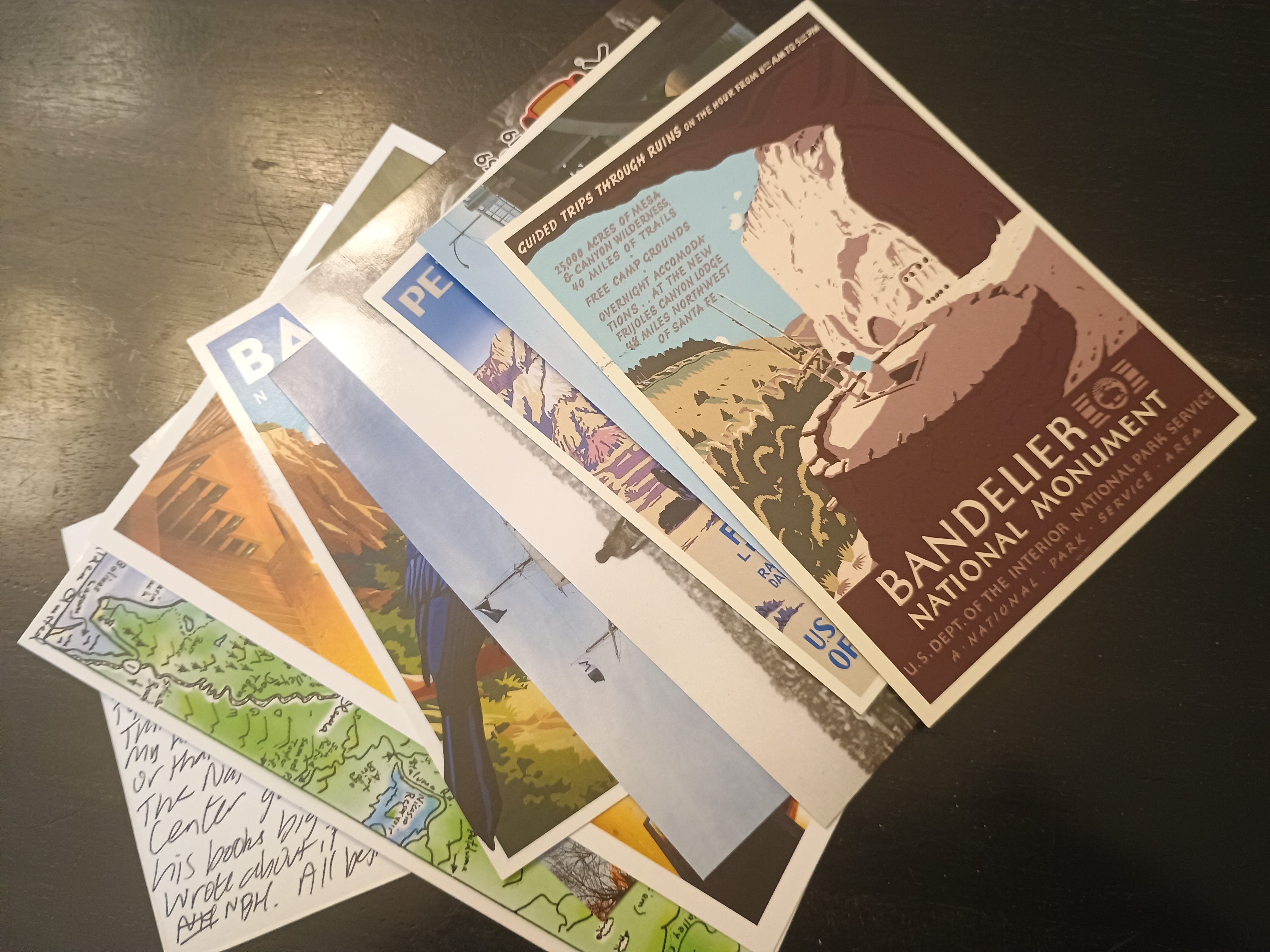
At irregular intervals, we draw names at Non-Boring House, and send the winners postcards, letters, small history-themed objects, or once in awhile, NBH merch (although we've had to limit sending the heavy things to US readers only, because parcel post now costs $$$)
Giftmail drawings are only for Nonnies (paying annual and monthly subscribers to Non-Boring History) as a thank you for your support. This perk is completely optional and free of charge. Many Nonnies are happy to know me only as words on a page, and I respect that. As I have often said, I have no interest in getting culty on you.
But if you like the idea of getting occasional fun mail from me, there's yet another reason to join us as an annual or monthly subscriber!
The original version of today's post appeared at Non-Boring History in April, 2025.
Coming Soon!
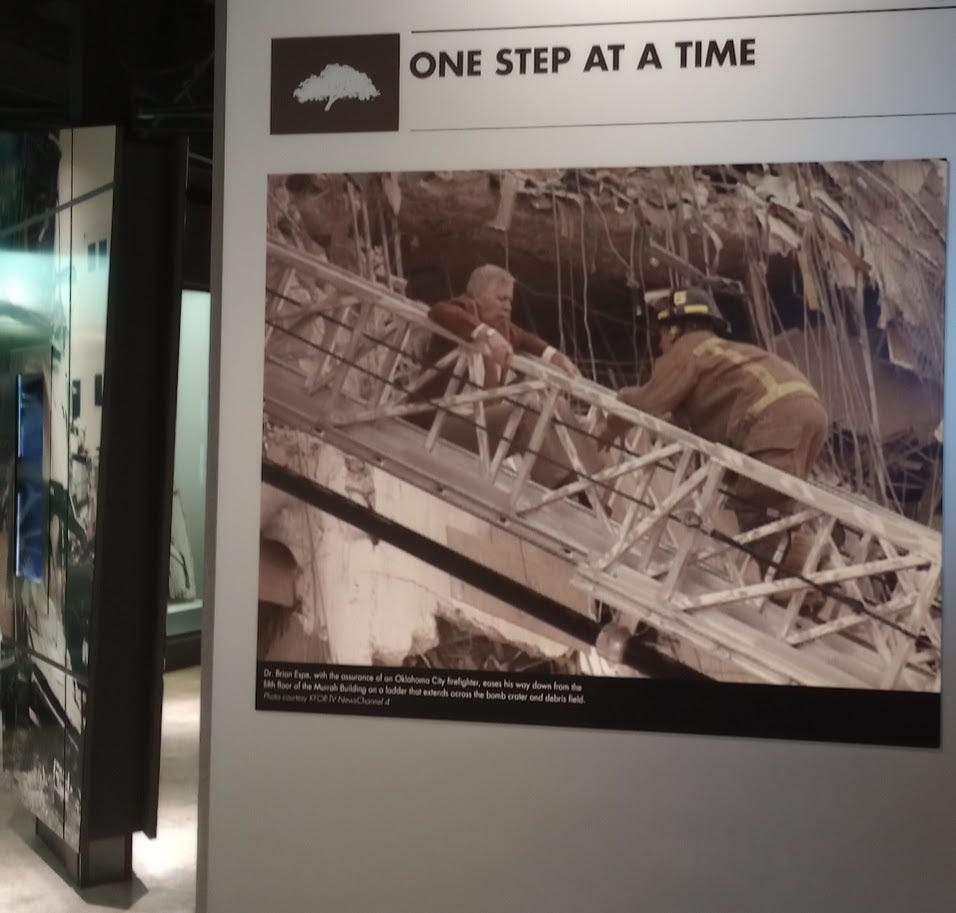
Another museum about civil servants, and especially federal government workers? Oh, yes. But this will be a very different post.
Read all about our visit to Oklahoma City, when you become a paying subscriber at Non-Boring History.
Non-Boring History is written by Dr. Annette Laing, recovering academic historian and missionary for history.