

He's Baaaack . . .
ANNETTE ON THE ROAD Annette visits the late President Richard Nixon, and remembers why she once taught about him

Note from Annette
The dreaded tech with a mind of its own sent out an earlier draft of this post. I’ve restored the final version. —-A.
Now you see that Richard Nixon is today’s subject, you must be seriously questioning my alleged objections to Great Man history at Non-Boring History. Just to add to my sins, my most recent post was on Adlai Stevenson. Don’t know who he is? Here’s what I had to say:

But, am I really writing about another Great Man today? Maybe not. I’m writing about Richard Nixon!
Sorry, Nixon fans, I couldn’t resist. In the end, I promise, there’s plenty here to offend everyone, no matter what you think about Richard Nixon. Simply dubbing someone a hero or a villain, no matter how much we think they deserve it, doesn't help us understand the past, or get the best takeaway that learning history has to offer: Humility and doubt.
Oh, and not much previous knowledge of Nixon required today (you’ve heard of Vietnam, China, Watergate, right? Good enough!) In fact, the less the better, because my own Nixon knowledge is pretty minimal. I’m taking you on a too-short taster tour of the museum at the Nixon Library, and trying to show how, as people who don’t know everything, we might resist being taken for a ride. In my defense, I’m a historian of early America with a bit of modern Britain, who shouldn’t have been expected to teach stuff she didn’t know—but often was. That said, I did once teach about Richard Nixon, and I did it by choice.
Most American professors teach about history they hardly know, or sometimes really don't know at all, and typically not by choice. That’s not great, true. The silver lining, though, is that we can show that we don't just transmit “information”, or serve “the material” on a platter, which is what too many people think college education is all about—that and passing the tests and getting a job. We model human skills that AI doesn't seem to cultivate: curiosity, love of learning, willingness to admit ignorance, willingness to keep an open mind, human connection with our subjects and our students, humor, and even joy, as something ignites in our brains. Early in my career, long before I finally realized that modern universities and their obsession with measurable results simply got between me and my mission in life, I chose to teach about Richard Nixon, to do more than to give him a passing mention in my breakneck US survey class. That’s because I had a hunch that we would all benefit, my students and me, from taking some time to consider why we think what we think about the past, no matter our views, and how that understanding affects what we think about the present and future. That’s what a history class is supposed to do.
Richard Nixon, Recalled
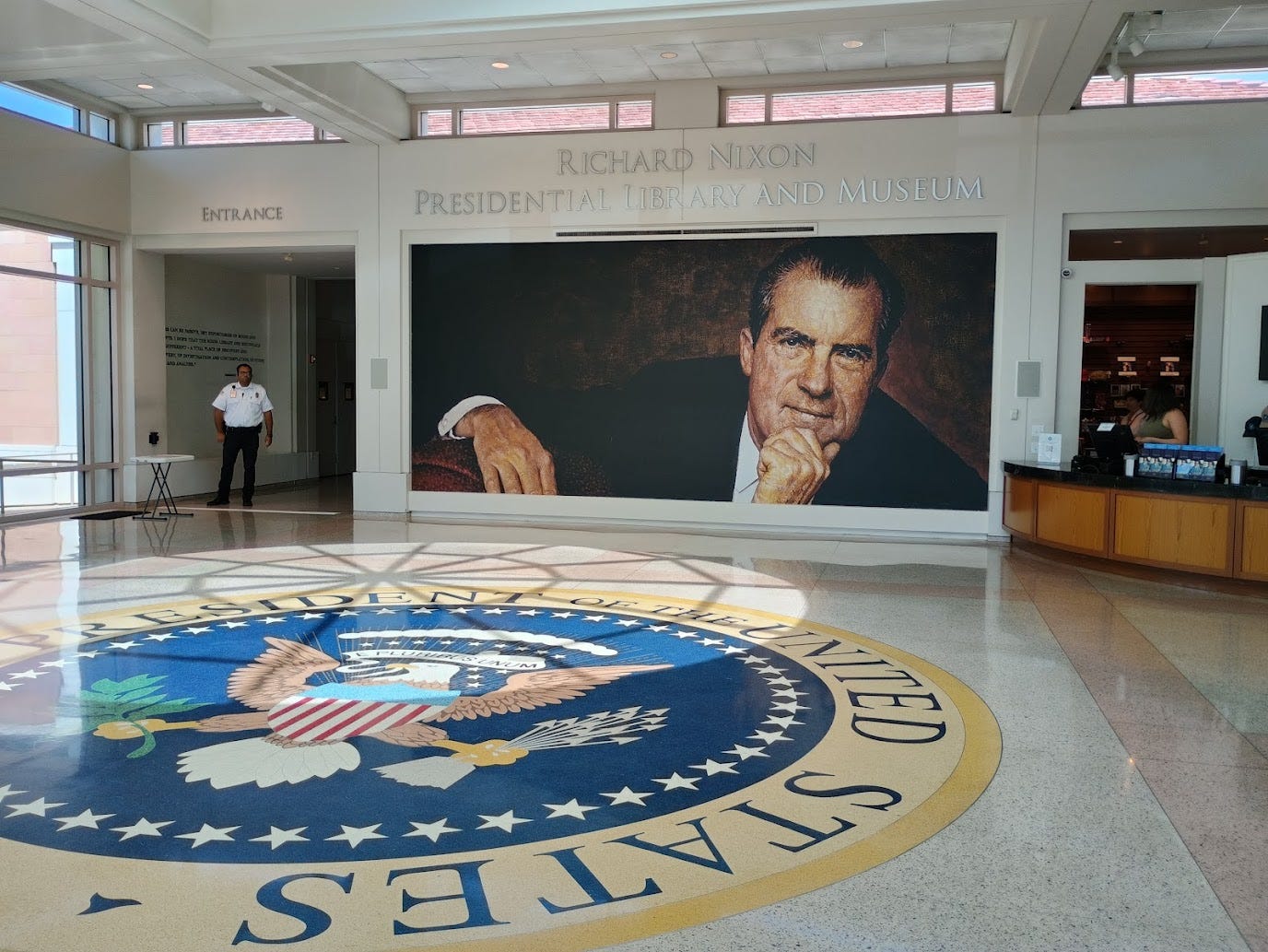
“You're looking well, Mr. President,” I said politely. “Death becomes you.” I was shaking hands with Richard Nixon in the lobby of the Richard Nixon Presidential Library. We stood on a huge rendering of the US Presidential Seal, conveniently placed just in case any of us visitors had forgotten that Richard Nixon was once US President. No, the Nixon years weren’t just a weird fever dream.
“Thank you, Dr. Laing,” the late President said, with a slight quiver of his jowls. “I want my fellow Americans to know that I am still not a crook, and that I’m feeling better than ever.”
“I can see that. And that big picture of you up there?” I pointed to the huge portrait that dominated the room. “Very relaxed, very modern. Not at all the very formal image I remember you had in the Seventies.”
“That was a long time ago,” he said affably. “And as you so often observe, Dr. Laing, everything changes over time. Even me. My presidency is looking better and better these days, I’m told.”
“Well, sir, that might depend on who you ask.” His face fell, so I rushed to change the subject. “And how is Mrs. Nixon?”
“The same,” he said. “As beautiful as ever.”
Ahh, spring, when our thoughts turn naturally toward Richard Nixon! When we are tempted to forego the warm outdoors in Southern California for a visit to a mostly indoor shrine dedicated to America’s 37th President! Look, I can enjoy spring sunshine anywhere in the West. But I came to Yorba Linda, California, specifically, for only one reason: To visit the Richard Nixon Presidential Library and Museum, home to the late President’s archives, and exhibits interpreting his life.
The ghostly President Nixon now vanished, and I turned to Hoosen. “I don’t remember ever seeing a picture of Nixon looking like that,” I said, nodding at the giant portrait of a relaxed and smiling Nixon, the one in the photo above. “He always looked like he had a giant stick up his [expletive deleted].”
This post is even more of a riff than usual. I won’t cover even the “essentials” of the Nixon Presidency. Lousy survey classes and short attention spans attune everyone to think there’s a quick version of history worth knowing, and there really isn’t. My goals today are simply to get us (me too!) interested in Nixon, and get us thinking about how and why we learn about the past. I daresay China and Watergate will pop up.
This post is also only partly about Richard Nixon. It’s also about this historian bravely grappling with the subject of Nixon more years ago than I like to admit, yet too soon in historian terms (only two decades after Watergate), back when I knew even less than I do now, as a newly teaching not-quite-qualified historian, and also as a Brit, an outsider.
No matter your opinion or knowledge of Richard Nixon, I hope today’s post complicates him for you. He really is one of the most interesting figures in US history, whether you class him as a Great Man, or not, or -much better- if you are trying now to think about history without a rush to identify the goodies and baddies, which I strongly encourage you do. Good historians don’t think in black and white. I often hear regular folk tell me confidently that someone they read devotedly is a great historian, while I ruefully question whether the celeb they worship is really a historian at all. When I make the mistake of saying this aloud, I usually end up getting yelled at. But history demands we question everything, in good faith, and not just the things we don’t like.
Like a Bridge Over Troubled Water(gate)
Might as well jump in the deep end. In case you’re too young for Richard Nixon memories (as I am, TBH), the Watergate scandal was a Very Big Deal. So shocking, in fact, it made Americans way more cynical about politics and government. Watergate revealed a President who was not the person that many had innocently believed him to be, a principled and honest member of the heroic WWII generation.
Americans of both major political parties, Republicans as well as Democrats, came to understand that their President was personally involved in a cover-up of a hapless and illegal bit of political chicanery known as Watergate. With a presidential election imminent in 1972, Richard Nixon’s campaign aides from the wonderfully-nicknamed CREEP (actually CREP)—the Committee to Re-Elect the President— hired goons to break into the Democratic National Committee offices at the Watergate complex in Washington, DC. There, they planted listening devices, pinched documents that could be used against the Democrats and their candidate . . . and got caught in the act.
Almost as scandalous, Nixon’s secretly taped conversations in the Oval Office were also revealed during the Watergate scandal. The very existence of a secret taping system in the Oval Office (first installed by FDR) came as a shock to Americans, too, since they —bless you, friends—never have quite been able to keep straight the distinction between a President and a King. Presidents weren’t meant to be in on sleazy political tricks, but the tapes, as they were gradually released, revealed that Richard Nixon was well aware of Watergate.
Things got worse for people who clutched their pearls at Presidential shenanigans. I mean, to be fair, FDR didn’t even swear, not even in private. The same could not be said of Nixon. The Oval Office tapes were transcribed by Rose Mary Woods, President Nixon’s very loyal secretary. She replaced any naughty words with the prim phrase expletive deleted, although I have learned that not every word she replaced was an expletive by normal standards. Which is interesting, because I think a lot of shocked Americans have long imagined President Nixon dropping frequent f-bombs.
Richard Nixon would almost certainly have been impeached and convicted in 1974 if he had not resigned. He possibly could have ended up in jail for covering up the antics of CREEP’s dirty tricks squad. I do remember—young though I was- how Gerald Ford, Nixon’s successor, took a lot of flak for pardoning Nixon a month after his resignation. President Ford explained that he wanted to spare the nation the agony of putting its former president on trial after two miserable years of Watergate shattering all sorts of dearly-held beliefs. Thinking about it now, that sounds reasonable to me, and Ford was a decent man by all accounts, but I quite understand if you don’t agree that he was right about this.
Nearly a quarter of voters polled by Gallup in early 1974, at the height of Watergate, remained loyal to President Richard Nixon. But I think it’s fair to say that the President had brought together almost the entire nation by then in contempt for Richard Nixon: Republicans as well as Democrats were disgusted. Watergate, and Nixon’s resignation in 1974, seemed like ancient history to me when I arrived in California from England as a teenager in 1981. But to the American adults I quickly came to know, Nixon and Watergate were yesterday. This was something I only appreciate now: Seven years is really not a long time.
It took me a long time to grasp why the California grown-ups I knew in the early 1980s spit fire at the very mention of Nixon’s name. Before you imagine my friends as long-haired hippy-dippy Californians, I will tell you now that these people—like almost everyone I knew in Sacramento— didn’t match that tired stereotype.
Annette’s Aside: My Sacramento adult friends were many of them buttoned-down New Dealers, some of them Republicans, and many of them veterans (one was a Marine). And to continue my theme of “California’s liberalism is overstated”, note that the state not only turned Illinois-born actor Ronald Reagan into a politician (elected California state governor twice) but produced Richard Nixon himself, born and raised. My dear Sacramento has never exactly been a hotbed of radicalism, but it was not nearly as conservative as was Richard Nixon’s birthplace of California’s Orange County. Living in Southern California in the late 1980s and early 1990s, I often heard jokes about living “behind the Orange Curtain.” Orange County wasn’t just conservative, you see. It was positively right-wing, one of the most right-wing places in America, a place that heartily embraced the very, very right-wing John Birch Society (which still exists, and whose members today include Steve Bannon and Alex Jones of Infowars. Yeah, that right-wing.).
Annette’s Long Aside: Tricky Dick, America, and Me
See Lizzie Borden, she’s one of the stars
And Tricky Dicky barkin’, flashin’ you his pardon
Oh, Jack the Ripper slashin’ your tires

—From Hellacious Acres by Kris Kristofferson (1976)
Even as a relative newcomer to these shores in the 1980s, I should have been aware of how big a deal was Richard Nixon’s quitting. After all, I watched him announce his resignation in real time, as a child growing up near London. I was nine years old. My dad woke me up shortly before two in the morning and hustled me downstairs, explaining “The American President is going to resign. This is the first time this has ever happened.” Sleepy but interested, I settled on the sofa as he switched on our rented TV, our first-ever color set.
As I watched, I felt sorry for Richard Nixon. I really did. I knew who he was. I had seen him on TV, because 1970s British kids watched the news (only three channels, nothing else on, TV always on). I had seen Nixon in China, Mrs. Nixon with the pandas, some mention of something bad called Watergate. Now, as I watched, President Nixon seemed to me to be holding back tears, and having never seen a grown man cry, I felt very awkward.
I just now did a memory check, taking a quick skim of the resignation speech on YouTube. I was surprised to see that the two veteran journos who commented immediately after the speech, Walter Cronkite and Eric Severeid, around the same age and of the same WWII generation as Richard Nixon, appeared more shaken and choked up than had the resigning President. I find myself wondering if I have muddled up the resignation speech with Nixon’s far more obviously emotional farewell to the White House staff, but I don’t remember watching that at the time.
Memories play tricks, sure, but our perceptions of the past keep changing for many reasons. The first and foremost is that historical context changes constantly, even when we don’t notice, and especially when we do. Consider the Presidency: A lot of Americans in 2016 found President Trump’s, shall we say, informality refreshing, while others, appalled, have expressed longing for a return to a more formal communication style from the White House. That sudden shift in White House norms may be having an impact on how people think of Richard Nixon, who was definitely old-school in his self-presentation. Even Nixon’s disgraced Attorney-General John Mitchell’s widely-reported and shocking warning to genteel Washington Post publisher Katharine Graham, as her reporters Bob Woodward and Carl Bernstein investigated Watergate (Mitchell said that “Katie Graham … is gonna get her tit caught in a big fat wringer if that’s published”), seems slightly less shocking now. Still a bit gross. But less surprising.
Facts are the building blocks of history, but perceptions are really what make history challenging to write. How do we recapture the mood of a bygone era? Even talking to sharp ninetysomethings with excellent memories (which I do) doesn’t tell me as much as I would like, because they didn’t get stuck in the 1940s, but changed their takes as they aged, and in tune with changes in the times. This is why historians, while we use oral history interviews when we can, are deeply attached to archives, and the vast numbers of historical documents they contain. Imperfect though letters, diaries, memos, and other papers are as evidence (and what evidence isn’t imperfect?) they don’t change.
Unlike living people, papers are unsullied by nostalgia, present-mindedness, and wishful thinking. That’s why the most valuable part of the Richard Nixon Presidential Library and Museum is the Library—which isn’t really a library as people understand it, but an archive of Nixon’s papers, only open to researchers. And like any historian, I bring my own take to Richard Nixon or any subject of my times, fighting my own present-mindedness, wishful thinking, and 70s nostalgia as best I can.
Annette’s Aside: Swimmin Through the 1970s, and Teaching Nixon
Capturing the “feel”, the culture, of a bygone time is very hard for a historian or anyone else. I chatted recently with my niece, She Who Must Not Be Named On the Internets, SWMNBNOTI, aka Swimmin Benoti. Last time I mentioned Swimmin at NBH, in 2021, she was about to start high school. Now she’s an art history student at a small liberal arts college in California. She has a highly-informed understanding of the 1970s “vibe”. She’s a huge fan of 1970s icon Kate Bush, which is impressive, like me being a Glenn Miller fan in the 70s (which I was). Her fandom of Kate Bush makes Swimmin even dearer to my heart. Frankly, I get the impression that Swimmin understands the 1970s even better than I do. And I lived through them. As a historian, I shouldn’t be surprised: It’s hard to see the forest when you’re surrounded by the trees.
Be warned that Richard Nixon, that 1970s icon of [insert your preferred phrase], still has his hooks in my childish heart. I can’t claim that I ever wanted to study Richard Nixon as a professional historian. That’s because, first, I have only recently conceded that the Nixon Presidency might now belong to history rather than to the domain of current events. And, second, I have long been convinced that the best history is the history that includes everyone, because history that’s only about ‘Great Men’ leaves so many questions unanswered. I say that as someone writing about Richard Nixon, whose most recent post was on Adlai Stevenson (cough). Don’t worry, I plan to do something very different soon. Variety is the spice of Non-Boring History.
So I have had a bit of a soft spot for Richard Nixon ever since I watched him look so sad when I was nine.
The Reader Relations Gnome at Non-Boring House welcomes your comments on Dr. Laing’s surprising feeling of sympathy for Richard Nixon. Please record your remarks on reel-to-reel tape, deleting any expletives, and then—and this is important— wipe clean the 18.5 minutes of your commentary that you believe most valuable. Finally, please refuse to send the tape to us until we issue a Congressional subpoena for it, and the Supreme Court of the United States orders you to pop it in the mail to us. Thank you.
I didn’t want to devote my life to studying Richard Nixon, but, early in my career, I was keen to teach about him, as best I could: He was such a divisive figure, yet I saw in Nixon enormous potential for a non-partisan teaching exercise. In the mid-1990s, while finishing up my PhD in Southern California, I started teaching adjunct (part-time) classes. One of my first gigs was a class at a small community college (Brits: Open admissions, two year degrees, mostly vocational training, but all students were required to take history).
I had recently visited the nearby Richard Nixon Presidential Library and Museum in Yorba Linda, Nixon’s hometown, with a retired teacher friend. Having been founded recently, in 1990, and by friends and fans of the still-living President, who was at the grand opening, it was entertainingly biased. Now I had an idea for using this museum in my teaching: After having my students each read and report on one book on some aspect of Nixon’s career, I took them on a field trip to the Nixon Library, each of them to decide for themselves how the museum’s interpretation compared and contrasted with those of the historians and journalists who wrote the books. Without a transportation budget, my class carpooled to the Library.
“The Nixon Project” was a nice break from our otherwise standard plod through the superficial US history survey. This was my first time teaching how museums interpret history, and I had a blast. My students were diverse in every way, politically, generationally, and ethnically, but judging from their reactions and the class evaluations, they genuinely enjoyed the Nixon Project. It was an eye-opener to think about what a museum’s agenda might be. I was thrilled to see them respond, as people who had known only a simple choice between Nixon Bad/Nixon Good. Self-identified Democrats in the class were amazed and impressed that Nixon signed off on women’s rights, civil rights, and the creation of the Environmental Protection Agency. Republicans were appalled by what they learned about Watergate and Nixon’s conduct of Vietnam. Had I thought of it then, and better known my subject, I would have asked how much Nixon’s decisions reflected his own views, and how much they were directed by advisers (think Henry Kissinger), and especially public opinion and the need of a politician to get votes. No politician works in a vacuum.
I’ve been meaning to get back to visit the Nixon Library ever since, to see how it has changed since the early 90s. When I realized that it’s been more than thirty years, I made my return a priority. I still hesitated because, well, L.A. is a major detour from our destination, L.A. traffic is insane, and hotel prices even more so: Yorba Linda is near Disneyland, and no, I am not paying $500 a night for any hotel, ever, much less for a room in an economy chain establishment that would cost about $130-$150 anywhere else.
So last month, Hoosen and I came up with a cunning plan to visit the Nixon Library for less: First, we found ourselves a big discount with a coupon. Second, we spent the nights before and after in the unfashionable and affordable towns of Barstow and Bakersfield.
All told, we drove about 450 miles that day, with a three hour museum visit in between. Recall that I take photos of absolutely everything I possibly can at the places we visit, so museum visits for Non-Boring History are never casual affairs, they cost much time and money, and I do need your help to do this work, because most readers are chucking money at writers who affirm their politics by hiding behind the word “history”. This one ain’t.
Disorientation
On our way to the first exhibit hall of the Richard Nixon Presidential Museum, we wandered through a huge display of kids’ artwork. These were the submissions in an annual contest the Nixon Library runs among local schoolkids. This year, the official theme was the 250th anniversary of the US.
Richard Nixon and patriotism make for an awkward combination, from the perspective of 1974. I don’t doubt that the continued rehabbing of Richard Nixon is much of the thinking behind the youth art contest, as it is behind the Nixon Library itself. But young folk have their own ideas.
Orange County is far more economically and ethnically diverse today than it was in Richard Nixon’s early 20th century childhood, or during my years in Southern California in the 1980s and 1990s. Times have changed, and, to repeat, young people have their own ideas—they aren’t just receptacles for what adults tell them, as any parent or teacher of teens can tell you. One bit of art that earned an honorable mention in the contest was by an older teen with a Latino last name. Hers was a photo of a huge American flag hanging in a capitol building, probably California’s, maybe the national capitol in DC. She titled her picture “United Under Our Flag,” make of that what you will. Another photo, by a Latino teen of the same age, shows two passports—one US, one from Mexico—and a framed picture of a young man in military uniform. This is no longer 1974, and this was no reference to Vietnam, let’s put it that way.
Things have also changed at the Nixon Presidential Library and Museum. When I first brought students to the Nixon Library in 1993 or so, it was owned and operated by the Richard Nixon Foundation, a group of friends and supporters of the former president, ranging from old pals to grateful oil companies.
In 2007, the National Archives and Record Administration, a US federal government agency, took charge. Ever since, they have run the show in what I can only hope is an uneasy partnership with the Nixon Foundation—if it’s not uneasy, it’s not being done right. I could see the tug of war at times. In the end, however, the Nixon Library’s museum is like all Presidential Library museums—it stands by its man.
Speaking of standing by your man . . . As ever, I wanted to start this museum visit with the orientation film. Outside the theater entrance stood a perfectly-coiffed older lady, absolutely still. I briefly and weirdly wondered if this was a wax statue of Pat Nixon. But then she moved, and revealed herself to be not the late Mrs. Nixon, but a friendly volunteer with disappointing news: The movie theatre was under renovation. That was a shame: No matter how bad, an orientation film tends to hit on many key relevant aspects of a museum’s theme and makes more sense of the museum experience. Unprepared, we headed into the first gallery.
Richard Nixon: Decide for Yourself
Here’s how things began. A photo of Nixon, both arms outstretched, fingers in victory signs, and this text:
RICHARD NIXON: A LIFE IN THE ARENA
WHO WAS RICHARD NIXON?
From his humble beginnings until his death in 1994, Richard Nixon spent much of his life working and striving, rising and falling and rising again, and always “daring greatly” in whatever arena he entered.
The legacy of Richard Nixon’s 50 years in the arena— as Theodore Roosevelt called the political world— remains controversial: Was he a peacemaker or a warmonger? Did he bring the country together or did he divide it? Did he leave the nation and the world a better place or not?
The answers are far from simple.
So as you walk through these galleries, take a moment to step into a President’s shoes. Explore Richard Nixon’s life and career from the inside and come to your own conclusions.
Decide for yourself: Who was Richard Nixon?
Ooh! I endorse this question being asked of the visitor! That’s what any legit historian should do, while pointing out that the evidence on which our decisions are based is not always complete or without bias. I was keen to get started, to see how much evidence the museum would give that would allow visitors to come to any kind of deeper understanding of Richard Nixon and his times. I was skeptical. But what followed this panel, honestly, was a complete surprise, even a shock.
Out of Chaos
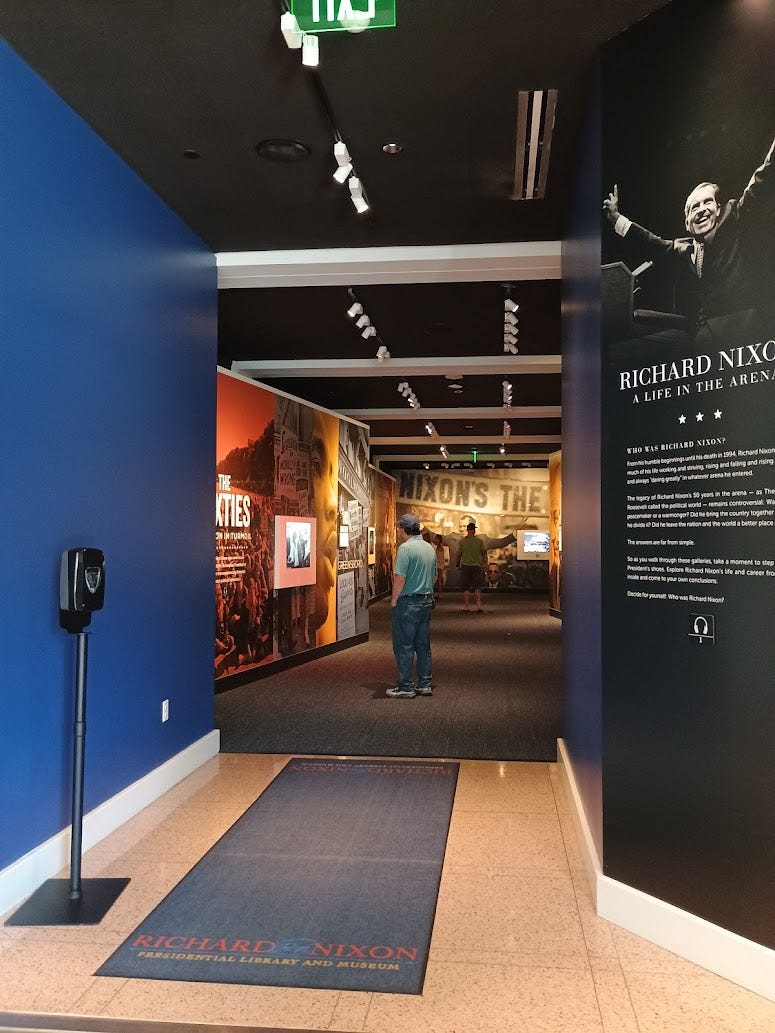
This very first exhibit didn’t start with Richard Nixon’s birth, childhood, and emergence as a politician. Nor did it start with Watergate, or with Nixon’s sort-of rehab in the early 1990s. It didn’t start with Richard Nixon at all. Instead, it began with the chaos of the 1960s that got Nixon elected to the Presidency in 1968, on a promise to restore law and order, and a stated determination to end the war in Vietnam, without US national humiliation. These were powerful selling points: Regardless of political label, most people rather like peace, stability, and predictability, not war and chaos.
And boy, was there chaos in America in the Sixties. This hallway took us through mayhem until we reached the photo mural of Nixon at the end of the hall, visible in the photo above, in which he was giving his two-handed victory wave, beneath a huge banner declaring NIXON’S THE ONE. Yes, he’s The One! He’ll bring our nightmare to an end! That’s what the slogan promised: President as savior.
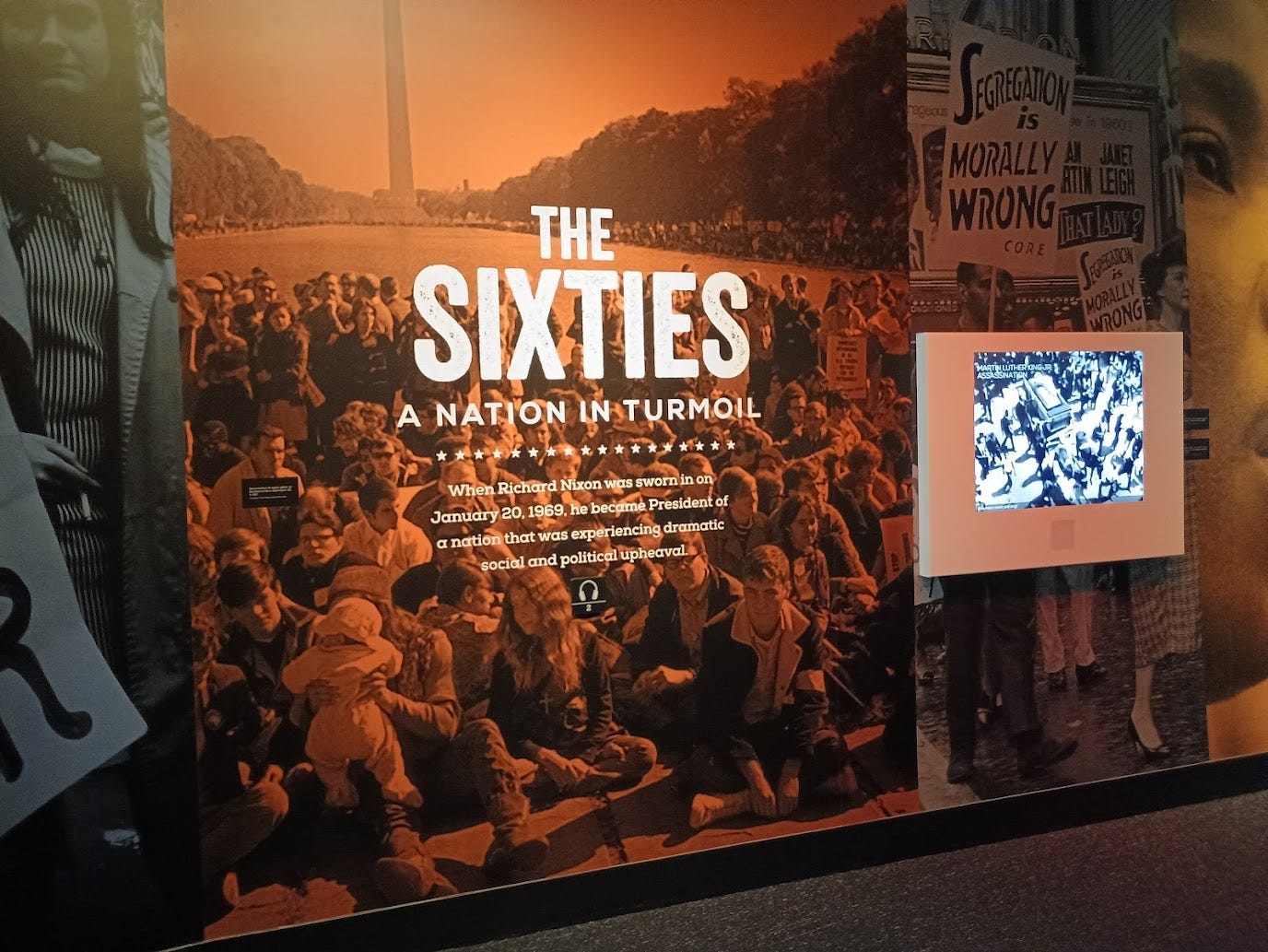
The Sixties: A Nation in Turmoil. That was the theme. At each step of the way, on both sides of the room, videos threw death, riot, and disaster at an unprepared Hoosen and me. I started noticing that while every video was different, clips of the same infamous violent events kept popping up in video after video. By the time we were done, we had seen more than once —just examples—the stunning assassinations of JFK in Dallas, RFK in Los Angeles, and Martin Luther King, Jr. in Memphis. The video repetition is intentional: No visitor who doesn’t just charge through the hall can escape the horror, the chaos, a message being shoveled on us. It was a bit of a relief to get to a smiling Richard Nixon. Which also made me think about what the Museum was saying.
The chaos hallway is not all negative, and that’s by design, too. Sympathetic photo backdrops portray, for example, the peaceful Civil Rights Movement, like the photo above, in which someone is carrying the sign “Segregation is Morally Wrong.” Even the Black Panthers, not a group that generally gets a fair shake from Nixon fans, is awarded a favorable set of images, of voter registration drives. Nothing is here by accident, as in every museum exhibit. The message, true or not, is that Richard Nixon had no issues with peaceful protest against racial segregation. The other message that came across to me from the text beneath the exhibit title (The Sixies: A Nation in Turmoil) is that Richard Nixon was not responsible for the mess he inherited, that he “didn’t start the fire,” to quote Billy Joel’s song.
True, Vietnam didn’t start with Nixon. The cluster[expletive deleted] of the 1968 Democratic National Convention, shaken journos and young protestors being roughed up by cops and hired goons, didn’t start with Nixon either. Violence against civil rights protestors before his election—not Nixon’s fault.
But now Nixon was here to save the day. Next up in the exhibits: 1968 election night, as seen on TV. California and Illinois voters go for Nixon, and that clinches it. Finally, TV journo Chet Huntley makes it official, declares to the nation that, indeed, Nixon’s the One.
That’s the big theme of this entire museum: As President, Richard Nixon played the lousy hand he was dealt, and he played it very well.
The hand he was dealt? The most conspicuous card was the Vietnam war, which was killing tens of thousands of young Americans by 1968. There’s more: Dysfunctional foreign policy that had done nothing to address the alienation of the Soviet bloc and China from the US, and which had taken America to the brink of nuclear catastrophe with the Cuban Missile crisis in 1962. Frightening domestic turmoil, from urban riots to serial killers. Who could fix all this? Why, Nixon of course! Nixon’s the One! Shame about Watergate and all that, but hey.
This was the mess, says the Museum, that Richard Nixon walked into in 1968, duly elected by a slim majority of voters. I thought about this. Nixon was elected with the conditional support of older Americans, including the parents of dead troops in Vietnam, Americans who had lived through WWII, the “good war”, who didn’t want to admit military defeat, even if that meant other sons being sent to Vietnam to die. He was elected by Americans who had voted for Franklin Roosevelt, who loved FDR’s New Deal, but who didn’t yet realize that the New Deal was now what held America together, the idea of a federal government that didn’t just let people sink or swim. Americans took for granted New Deal America, and postwar prosperity. The only way for Republicans to stay in office was not to challenge the New Deal consensus. Nothing suggested to most people that, in fact, the effort had already begun under Nixon to return Republicans to power, with the goal of eroding the New Deal project. This entire paragraph? My take. Not the Museum’s, but what they had inadvertently spurred me to think.
The Richard Nixon of 1968 was not presented by the Museum as a divisive figure. Quite the reverse. He was elected on a platform of bringing people together, and especially those he identified as his base, the “silent majority” of Americans. He promised to return law and order to America’s streets. He pledged to bring America peace (but with honor!) with an end to the Vietnam War. No hint of an attack on the New Deal, on federal government spending, especially on social programs, and especially not on Social Security, the New Deal’s greatest accomplishment. It would have been political suicide to attack the New Deal head on. Nixon was not The One to do that. But he would pave the way.
Unlike his Democratic opponent Hubert Humphrey, the Presidential candidate who emerged from the mess that was his party in 1968, Nixon did not heap praise on the Great Society programs of former President Lyndon B. Johnson. These had aimed to end poverty among Americans, including Americans of color. LBJ had instead spent the money on Vietnam. Humphrey, who had been Johnson’s vice-president, also staunchly supported the Vietnam War, so his appeal to a majority of Democratic voters was not obvious. Nixon had a clearer message, or so it seemed: Unite Americans.
I inspected a display of Nixon campaign badges. Many were in languages other than English, and especially Spanish. Let’s not assume that Nixon—or any politician of the modern age— was only appealing to white voters. He wasn’t. He couldn’t. America had already changed.
Peace and Love
In his inaugural speech as President, in 1969, Richard Nixon promised peace. Not just peace (with honor!) in Vietnam, but around the world, and especially within the United States. He pledged his support for civil rights, promising one nation of black and white, not two (Latinos and Asians and American Indians were backgrounded in this discussion, but I guess they were implied. Unlike the West, the East thought in black and white). On this issue, Nixon sounded more like an Eastern Establishment silver spoon liberal, the kind he didn’t trust, than the up-from-humble-roots California Republican he was. Heck, he even endorsed and increased affirmative action, the DEI of its time.
From the inauguration display, Hoosen and I walked directly into the Oval Office, or rather, the reproduction of the Oval Office as it appeared during the Nixon administration.
OMG, is that Pat Nixon hiding behind the lampshade???
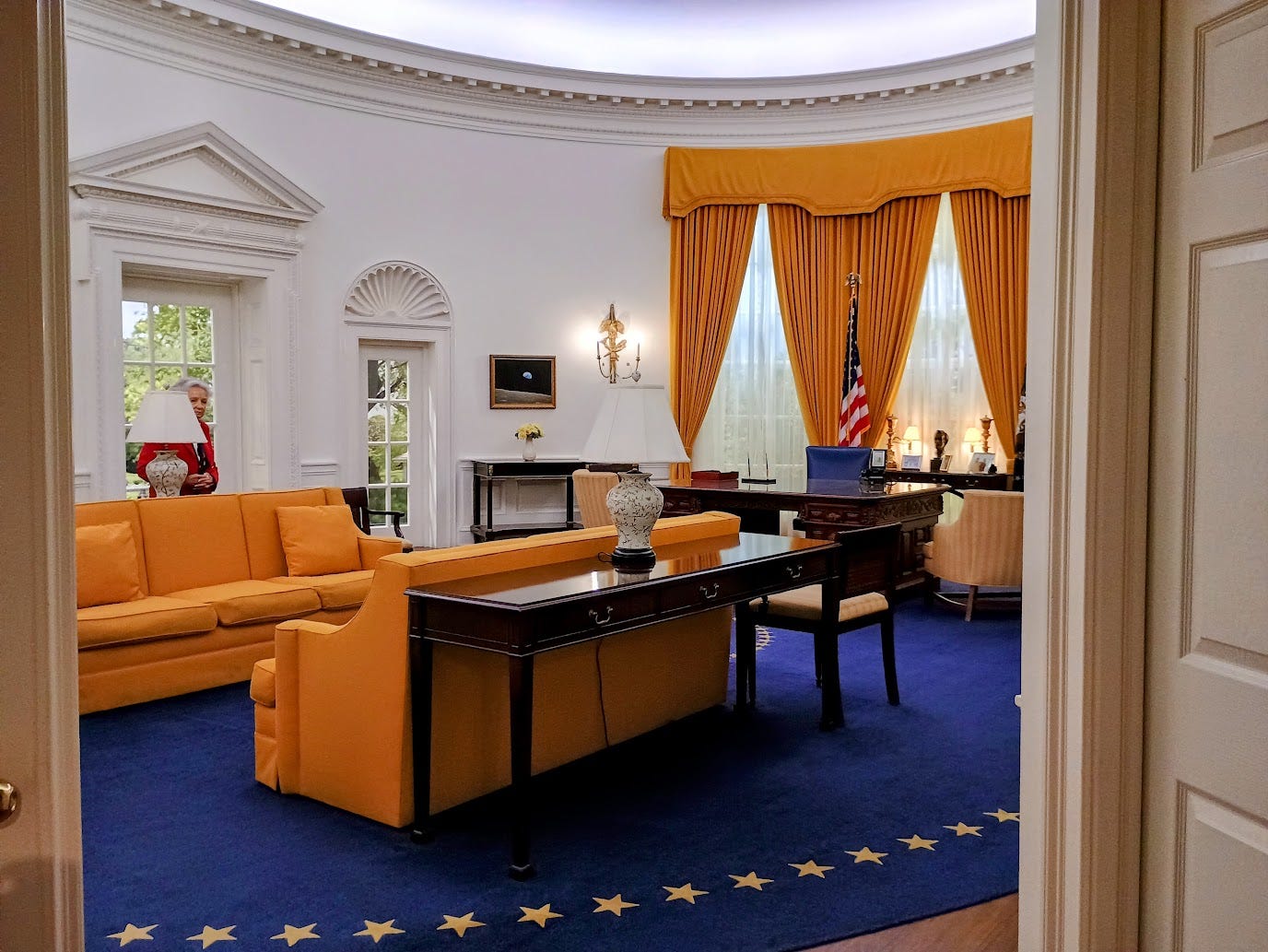
No, of course she was not the late Pat Nixon. I’m being silly and a bit crass. She was the same volunteer we had met earlier, and may I just say here, joking aside, how very kind and informative she was? I wish I had caught her name. She kindly took photos of people sitting behind the President’s desk, which is not—surprise— a copy of the famous Resolute desk.
Every President, she told me, gets to choose how to decorate the Oval Office, which made me think a bit. President Nixon preferred a desk he had been told was used by President Woodrow Wilson (it wasn’t) whom he much admired, so what’s in the pretendy Oval Office is a repro of Wilson’s alleged desk, not the better-known Resolute desk. The Resolute desk, our guide told me, was made from the remains of the HMS Resolute, a British ship sent to rescue the doomed expedition of explorer Sir John Franklin. Franklin had sailed to Canada in hope of finding a Northwest passage to the Pacific, and ended up, as tended to happen to such clueless 19th century adventurers , dead along with his crew. The Resolute, the rescue ship, was itself surrounded by ice and abandoned in 1854. But it was towed the following year by an American whaling ship, repaired, and returned to Britain as a diplomatic gift. In return, when the ship was hacked up in 1879, bits of it were made into the Resolute desk, which was sent to the White House (regifted, really). Ever since, most Presidents have used this desk (including President Trump). Richard Nixon was the notable exception.
Pat Nixon, the real one, was otherwise put in charge of Oval Office decoration. She liked gold. Not bright shiny gold, but the dull mustardy color called Sungold that was hugely popular in the 1970s, for reasons that escape me. So Mrs. Nixon picked out the gold sofas—or, rather, the originals on which the sofas in the Museum were based. The gold was reflected in the curtains and—nice touch—George Washington’s waistcoat in his portrait facing the desk. I sat on the fake Oval Office’s repro sofas, and admired how large and sparse is this room, a bit empty and functional. I was not surprised to learn that President Nixon preferred to work in a smaller, cozier space, with a comfy chair and an ottoman on which to prop his legs. Much better, especially for a guy who was prone to blood clots (something we have in common, me and Dick Nixon, just saying).
I looked through the French doors at a photo mural of the Rose Garden, a Rose Garden that still had a lawn, and thought of the East Wing in which Pat Nixon and her team worked.
From enjoying hanging out in the Oval Office (I took a photo of Hoosen sitting at the Resolute desk), we barely had time to catch our breath before we plunged into Vietnam. Same might be said for President Richard Nixon.
One . . . Two . . . Three . . . What Are We Fighting For?
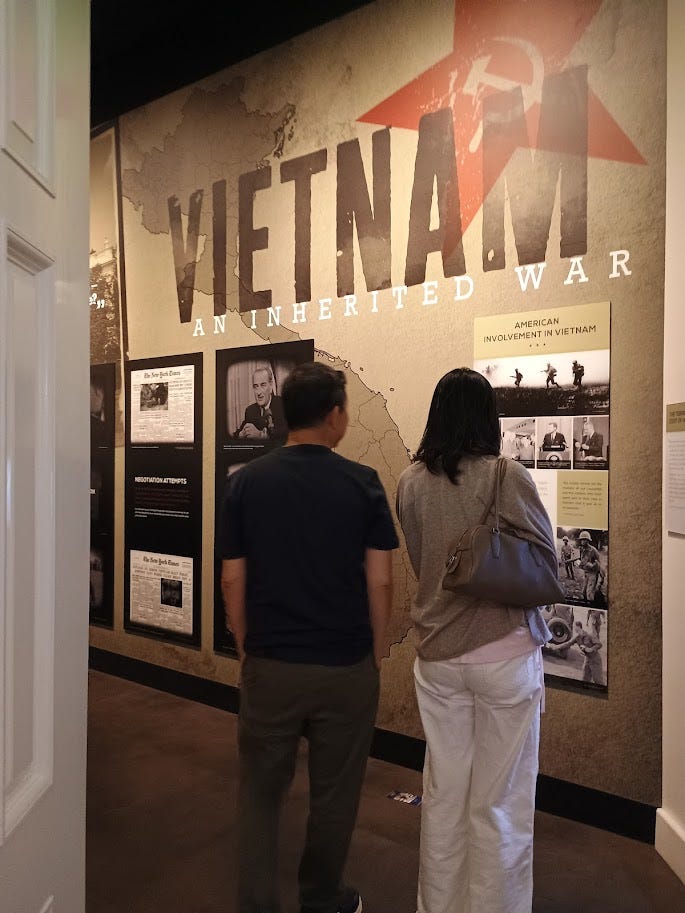
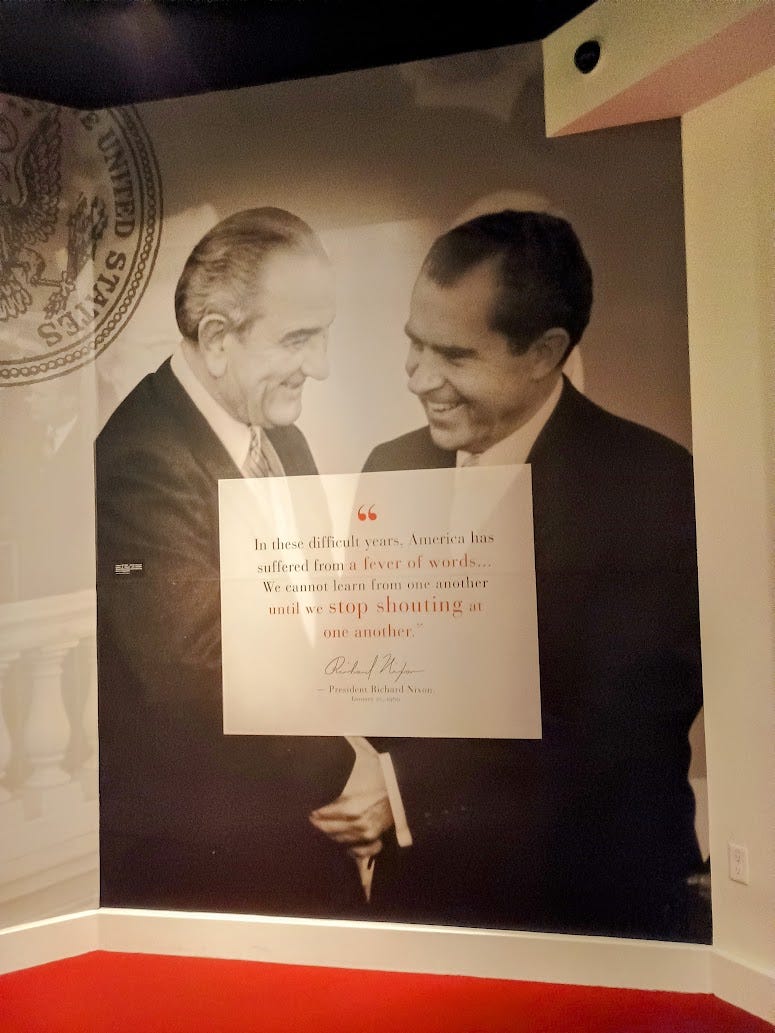
So much for that happy photo of Nixon and LBJ smiling, shaking hands, and looking bro-ish! We didn’t even get through the door into the Vietnam room before this message was shouted at us from the wall: VIETNAM, AN INHERITED WAR. Just in case we had forgotten that Richard Nixon didn’t start the fire.
Having dived headfirst into the crisis-laden times in which Richard Nixon became President, the late 1960s, we were now going deep into what was probably the most crisis-y crisis of the moment, the Vietnam War, with NOT NIXON’S FAULT ringing in our ears.
I don’t know how many visitors to museums pay close enough attention to take in museum messages, whether consciously or subliminally, however loudly they’re shouted from the walls. Most people think of museums as places where Important Things are Stored, and so focus on the artifacts, rather than on the stories being told through text. But if visitors are paying attention at all to words, they get this: Vietnam was not Nixon’s doing, you know! It was the Other Guys who started it!
But, Laing, isn’t that true?
Oh, heck, yes, reader! American involvement in Vietnam (then French Indo-China) started under Nixon’s predecessors. I’m not even talking his immediate predecessor, the guy most associated with the war, Lyndon Baines Johnson. I’m not talking JFK. The mess we call Vietnam started under Dwight D. Eisenhower, or maybe even earlier, with Harry Truman following the mistaken belief that all Communist nations were in cahoots with each other. Eisenhower started sending money and military advisers. JFK escalated the war a bit. LBJ escalated it a LOT.
It’s also true that every President inherits a bushel of problems from his predecessors, from Congress, and from the past in general. But Nixon, no question, took decisive action which put him firmly in the driver’s seat of the Vietnam War. He announced his plan of action to the American public in early 1970, after a year in office, and after he had successfully campaigned on a platform of peace “with honor” in Vietnam. He had already ordered the invasion of neighboring Cambodia. The museum frames this action as “Pursuing the Peace”, arguing that Nixon took this drastic step, expanding the war to end it, only because the North Vietnamese and South Vietnamese governments had refused to compromise. Whatever the truth (and I honestly don’t know) this is not how the invasion announcement was understood at the time by huge numbers of Americans, especially among the young. As my old professor of British history John Phillips liked to say, perception is reality. It shapes what people think and do.
Again, I felt the inadequacy of my knowledge to do more than just perceive, and be a bit skeptical. The invasion of Cambodia—a matter of foreign policy— and the American public’s response to it—which is really part of domestic affairs— much less the entire Vietnam War—can’t adequately be summed up in a paragraph or two on the wall of a museum, much less in this post. To be sure of what I’m talking about, I need to read books on the subject of Nixon and Vietnam. As does anyone who seriously wants to know, much less claim any kind of expertise. This is why historians commenting on the present or recent past have no business presenting ourselves as infallible expert guides who never make mistakes.
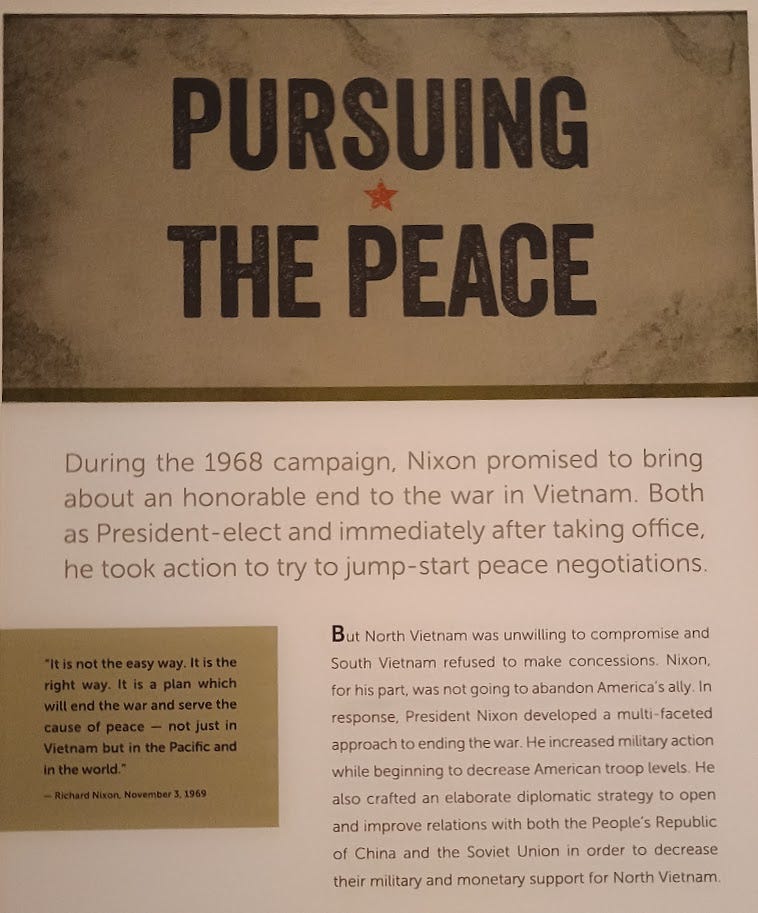
Interesting that this panel says that Nixon “increased military action while beginning to decrease American troop levels.” Hmm. It doesn’t actually say what military action he took, and how “increased military action” decreased the number of American soldiers in Vietnam. Basically, I guessed that since he had ordered the US Air Force to drop bombs on Cambodia from a great height, fewer American ground troops were needed. I am not passing judgment on this, but I am interested that significant details were not mentioned at all in this panel, the one most likely to be read by visitors.
Similarly, the info panel explains Nixon’s big strategy in foreign policy, including ending the Vietnam War the “right way”, not the “easy way”, by defrosting relationships with the USSR and China. But it doesn’t explain that many Americans were upset by the President’s announcement, or why.
And American public opinion, regardless of facts, mattered. Something that had changed by 1969 was that, unlike previous wars, Vietnam was coming into American living rooms every night, and in living color, and Americans were making up their own minds about the war. Iconic newsman “Uncle” Walter Cronkite was among them: He had actually visited Vietnam, in early 1968, chatted with troops, and come to a conclusion. In a highly unusual on-air editorial, Cronkite pronounced the war unwinnable. LBJ was now convinced that his presidency was doomed. But whether Cronkite actually changed views on the war—including his own—is debated. No doubt, TV, like social media today, exposed more American civilians to the sights of war, and those who felt betrayed by Nixon were genuinely distressed by what they had witnessed in their living rooms.
This Vietnam room had lots of images of American servicemen being brutalized at the so-called “Hanoi Hilton”, a notorious prison camp where the North Vietnamese refused to extend the protections of the Geneva Convention to POWs they had labeled “war criminals” for simply participating in the war. To the museum’s credit, it points out that the South Vietnamese government, America’s ally, also mistreated captured North Vietnamese soldiers. This was complicated.
Speaking of multiple perspectives, the Vietnam room features a large photo of Nixon with telegrams (think emails today) piled high on his desk. In front of the photo are stacks of the actual telegrams, from the archives. Whether reflecting reality or not, and I genuinely don’t know, the telegrams in the display that visitors can read have a definite bias toward those in favor of continuing the war:
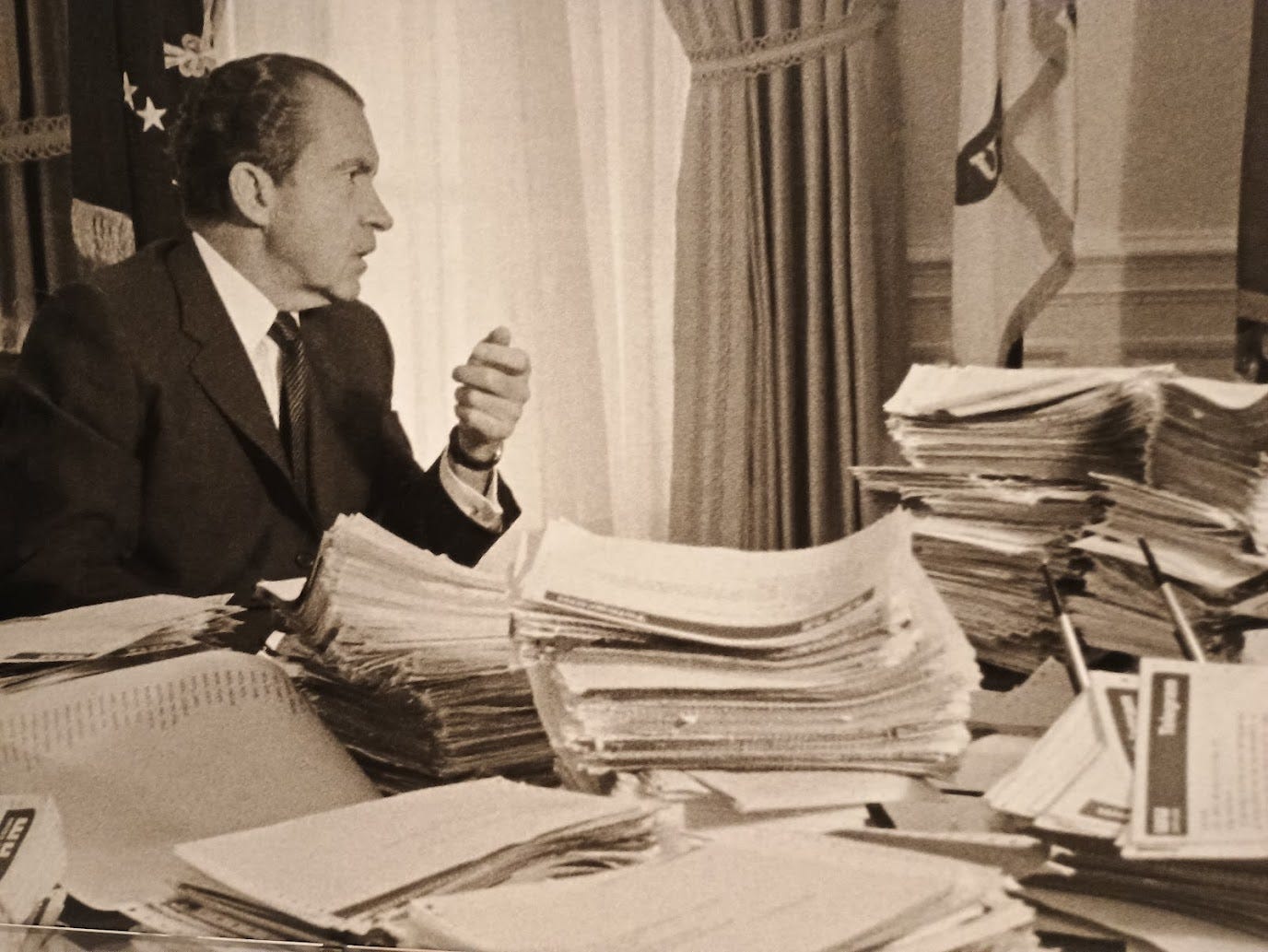
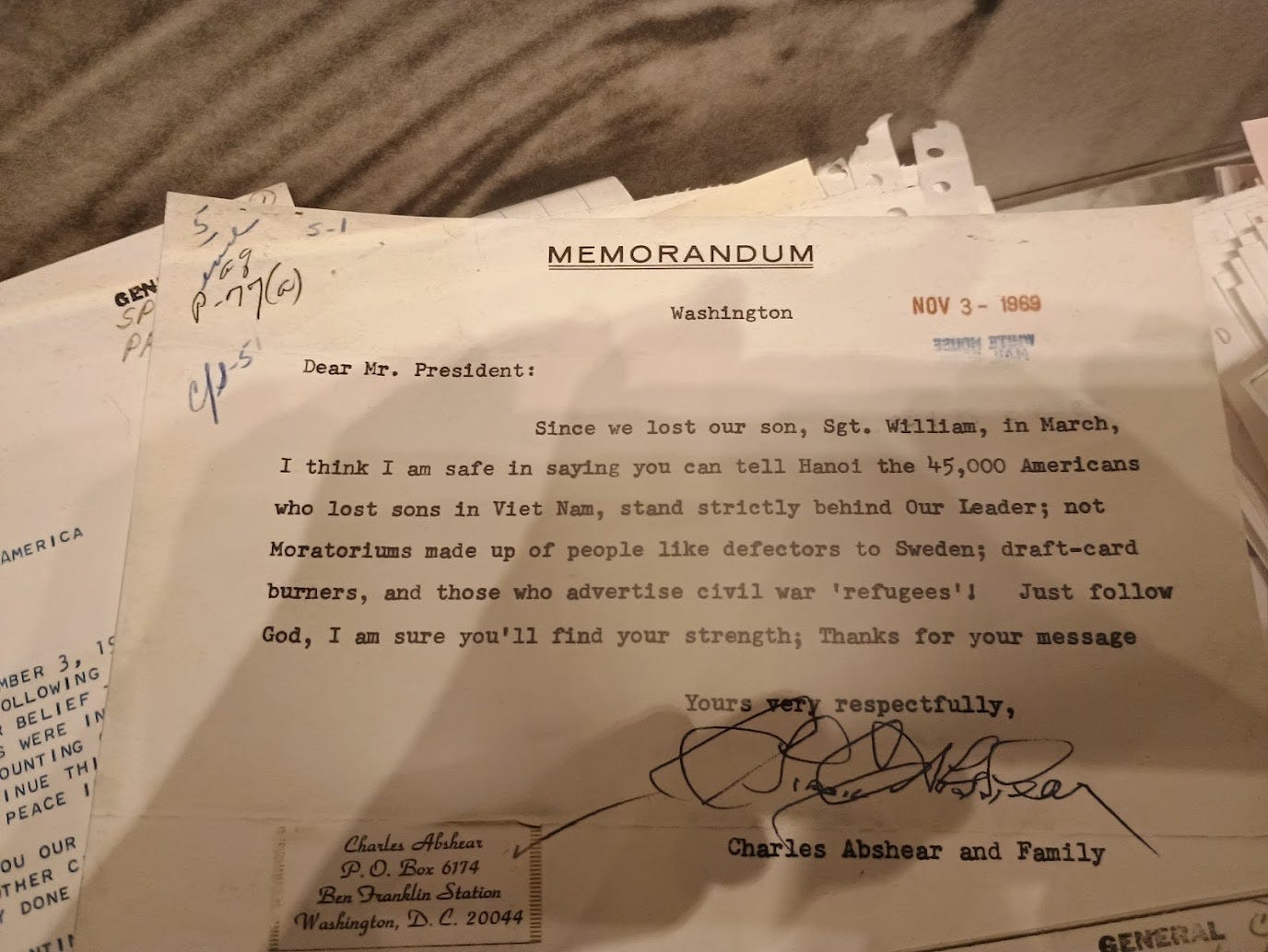
While the Vietnam room shows many photos of the American prisoners of war who were brutalized by the North Koreans, it does not depict their torture—which while apparently not caught on camera, absolutely happened. But photos of the human suffering that most increased the American public’s revulsion toward the war, such as the 1972 image dubbed Napalm Girl, of a screaming child who had just been doused in burning jellied gasoline by South Vietnamese (US allied) planes, and another (“Saigon Execution”] of a young Viet Cong fighter being summarily executed by a South Vietnamese officer (an American ally) in the street, are also missing.
In fairness, both of these horrific images could be exhibitions by themselves, given their complicated contexts. At the time, Americans got little context or complication from their TVs. But just as one small example of details that can give us pause today, decades later: The South Vietnamese general who shot dead the young fighter later emigrated to the US. When his identity was revealed, and he was threatened with deportation, he was allowed to remain by intervention of President Jimmy Carter, who called the case against him “historical revisionism”. Er, what? This begs the question of why Carter came to his defense. That, I don’t know, and don’t have time to get into, but wow, right?
All of this made me uncomfortably aware of how little I know about Vietnam, Jimmy Carter, and Richard Nixon, and how vulnerable I am in any Presidential Library Museum, institutions not known for their impartiality.
This is also why trying to learn “everything” about the past isn’t nearly as valuable as learning a few things deeply and well enough to understand that it’s all complicated. History should breed humility about the depth of our knowledge.
That’s asking a lot of the public, and the public includes me. I’m an early Americanist, and I bring some skills to every museum and historic site I visit, but Nixon? I find myself more surprised than ever by how complicated he and his legacy seem to me.
Domestic and Foreign Accomplishments
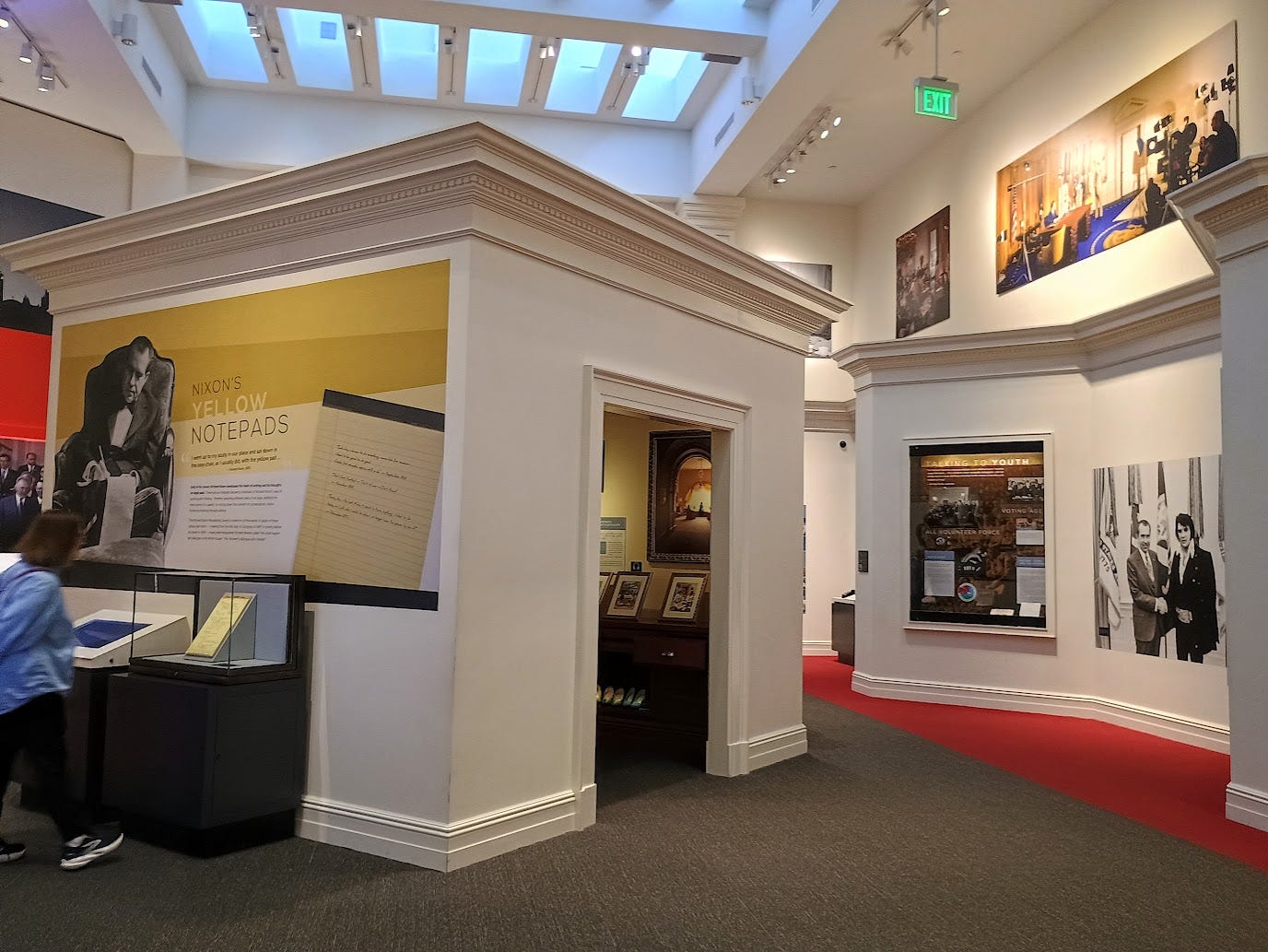
Complicated history does make the brain hurt, like a good workout. Maybe that’s why, after the messiness and misery of the Vietnam exhibit, it felt like a relief to get to the bit of the Museum celebrating President Richard Nixon’s finest moments. I only have a couple of vague memories of my last visit to the Nixon Library, three decades ago, and one is of what was then called (I think?) the Domestic Accomplishments room, a brightly-lit space dominated by classical columns and rows of American flags.
Now, in the updated Museum, the highlights of the Nixon Presidency —foreign as well as domestic—are celebrated in a big space with other rooms off it. In the middle—awkwardly—is a strange little hut, which is not about Nixon’s Yellow Notepads as the photo suggests—that display is on the outside—but about Pat Nixon as First Lady. Here was Pat, hidden away in purdah, in her hut, and yet the exhibit suggested she was quite the feminist. Ooooh—-kaay then.
Pat Nixon, feminist? That’s a bit of a stretch to anyone who has ever been fascinated by videos of an apparently frozen Pat Nixon devotedly gazing at her husband with a glazed half-smile. The early 1970s teased us with the idea that women might actually be people, so I can’t blame the Museum for making a valiant attempt to include the First Lady, then known formally as Mrs. Richard Nixon (BTW, I was shocked by this “Mrs. Joe Smith” nonsense among older women when I came from the UK to California in 1981. Good Lord.) Displays showed Pat Nixon looking keenly interested in cancer research. Hey, Richard Nixon approved billions of dollars in funding cancer research! The Museum does not, so far as I could see, also note that he made big cuts in science and medical research more generally.
(BTW, your eyes don’t deceive you: In my photo above, there’s a big copy of the famous picture of Nixon and Elvis Presley, from when a slightly drugged Elvis turned up at the White House to offer the President his personal help with the Vietnam War. Can’t make this stuff up.)
Only Nixon Could Go to China
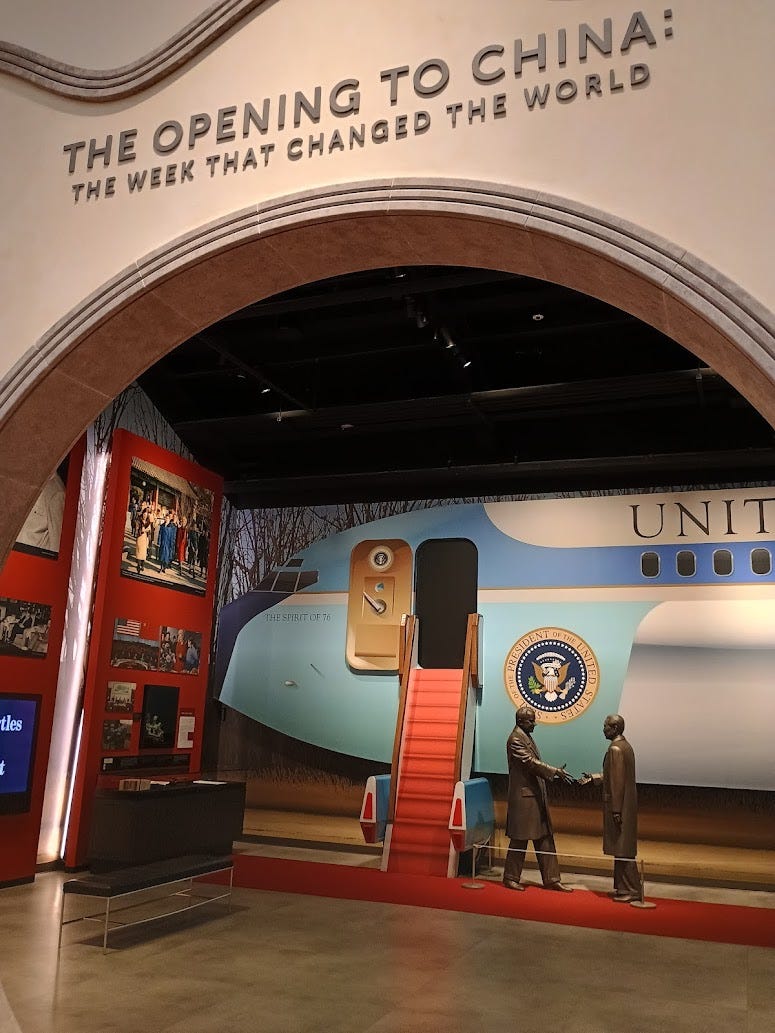
No question, Richard Nixon’s visit to Communist China was the highlight of his Presidency. He was Mr. Anti-Communism, after all: He had launched his political career as a leading light on the House UnAmerican Activities Committee, which led the charge against Communists (and alleged Communists) in every area of American public life. That’s why, as the saying goes, “Only Nixon could go to China”. This astonishing step was a sign, I suppose, of Nixon (or, more to the point, his Secretary of State Henry Kissinger) thinking out of the box. Nixon, the museum told me, was realizing how America and the world could benefit if America could stop lumping all the Communists together as the Red Menace, if he could drive a wedge between China and the USSR, and deal with them separately.
The upshot? Ping-pong, pandas at the Washington Zoo, global trade, the building of the World Trade Center in New York, a step back from the nuclear brink, and, in our times, a huge influx of cheap Chinese stuff coming into American homes, for better and for worse, allowing us to pretend we’re all rich while our incomes decline. There was more, a massive amount of knowledge, especially science and manufacturing, making a one-way journey to Beijing. I remember one of several academic colleagues (not in history) who participated in an exchange with a Chinese university about twenty years ago. I asked how his visit to China had gone. “Oh, they were very interested in what we do,” he said in surprise. “I bet they were,” I muttered cynically. I mean, even the very little I had learned about Chinese history told me the Chinese were historically very keen on nicking, I mean, borrowing ideas from wherever they could without getting too much involved with foreigners. But I digress.
Missing in Action
So Nixon created the federal Environmental Protection Agency. He also signed off on Title IX, creating funding for women’s sports. He signed the go-ahead on all sorts of liberal causes, including affirmative action… maybe because, politically, what else could he do? I mean, I hate to quote Otto Von Bismarck, but politics really is the art of the possible: You can’t go up against the collective will of the people if you value your career in elected government. If Nixon wanted to push things to the right, even just to make Republicans more electable, he had to start where most Americans were, which was basically satisfied with what FDR had put in place. And that meant the only Republicans getting elected to the Presidency were men who didn’t openly challenge the New Deal, men like Eisenhower and Nixon.
Neither here nor anywhere else, so far as Hoosen and I could see, did the Nixon Museum discuss the origins of the Southern Strategy. Richard Nixon and Arizona politician Barry Goldwater (who lost the Presidency in a landslide to LBJ, a white Southerner with progressive views on civil rights, in 1964) realized that Republicans might never again run American government except as, well, Pretendy Democrats. So they began exploring how the Republican Party might change things, first by recruiting the huge number of white Southerners angry with the Democratic Party’s role in promoting civil rights, by tapping into their racism without admitting that this was what they were doing. This policy later proved wildly successful in electing Ronald Reagan—please bear with me here, Reagan fans. Ever wonder why Reagan launched his 1980 Presidential campaign by talking up states’ rights (which were never discussed in the mid-19th century without reference to preserving slavery—seriously) in a tiny Mississippi town called Philadelphia, which was known only for being where three young civil rights workers were murdered in cold blood in 1964? I’m afraid there’s only one answer to that: The Southern Strategy. Ronald Reagan didn’t start that fire, but his fellow Californian Richard Nixon did. Again, neither Hoosen nor I saw a single mention of the Southern Strategy in the Nixon Museum. If it’s there and we missed it, I’m sorry, but it’s well-hidden.
Watergate, Then and Now
Can’t hide Watergate, of course. Which is not to say that the original version of the Museum, which I toured in the 90s, didn’t try. It offered a Watergate display that, regardless of their politics, my students found hilarious. The Watergate exhibit was a narrow darkened hallway, with a sparse and dry Watergate timeline presented on a black background in tiny lit-up letters. Even if you could get interested enough to try reading said timeline, you would soon feel pressure to move on as other visitors crowded in behind you. And on either side of the floor stretched those little lighted strips you get on airplane aisles: Hurry up, folks! You need to leave! Keep walking! Nothing to see here!
Today, Watergate is still a timeline in a hallway, but although the hallway is now wide and well-lit, it features far more text than ever.
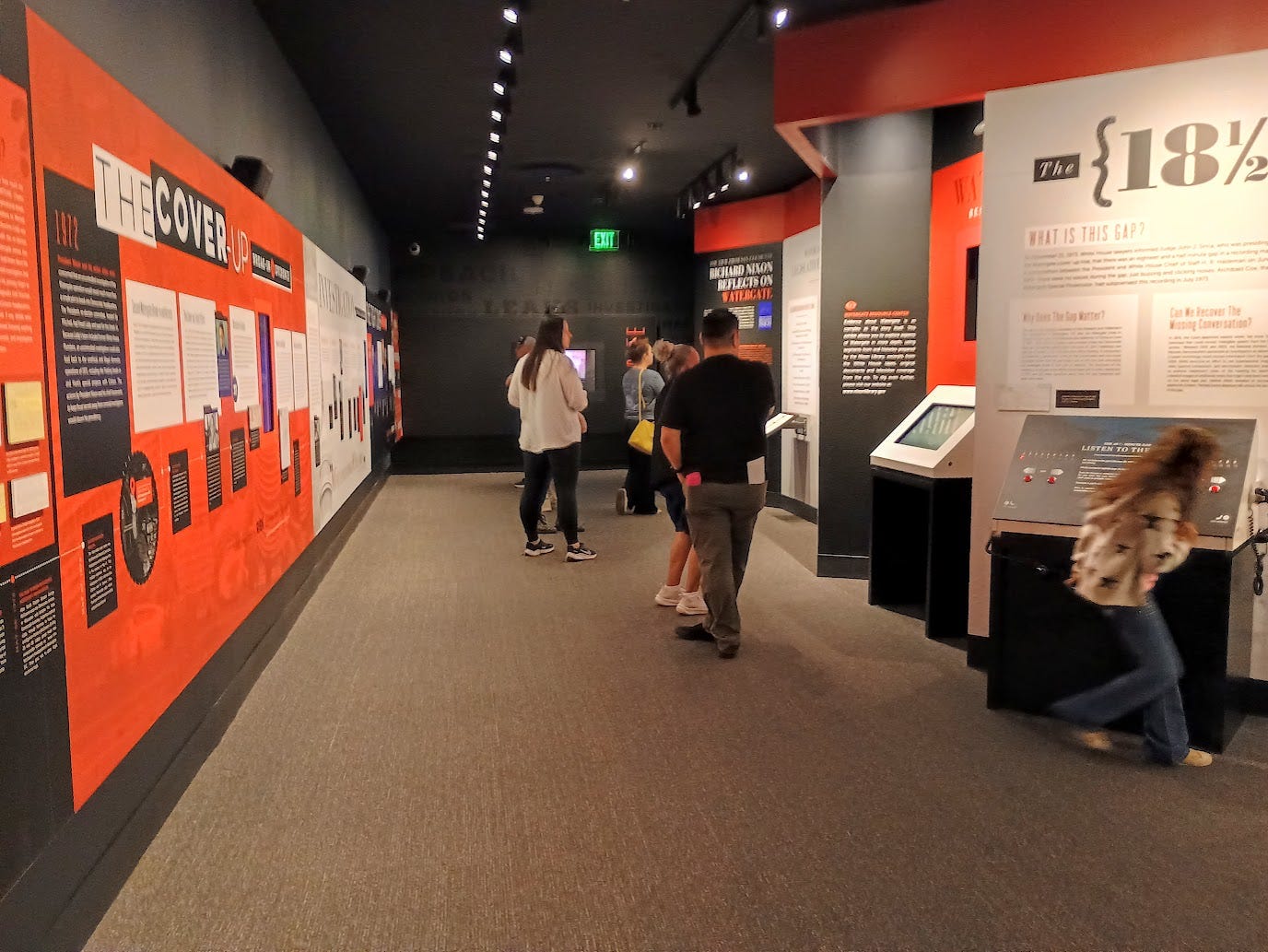
Really, if the museum is serious about teaching Watergate, it ought to offer a movie. I looked at bits and pieces of the displays, but it was just too much text, even for me, and especially to read and try to take in while standing. Video clips include an interview with Nixon aide Chuck Colson, who I just now learned was described as an “evil genius” by a journo who covered him, and as a “hit man” by his colleague and fellow Watergate conspirator H.R. Haldeman, which is really saying something.
Colson was among those aides to Nixon who, unlike Nixon, went to prison for Watergate. As soon as he was accused, Colson announced his sudden conversion to evangelical Christianity. Conversion to Christianity, which can happen in a moment in the evangelical creed, is a convenient and perfect form of image rehab in America—and what sort of terrible person would question Colson’s sincerity? Well, me for one, because a claim of having accepted Christ tends to insulate shamed Americans from any further criticism. I have long said that I would be much more successful if I just called myself the Reverend Annette. I’m looking up more stuff just now, just some basic facts, and I learn Colson was released from prison early, after only seven months, because of a family crisis. And what was that crisis? His college-age son was arrested on drug-dealing changes, and needed Daddy at his side. Can’t make this stuff up.
This is one of the enormous challenges of writing NBH: The more I know, the more I want to learn, and then I have to figure how to share with you in a post that doesn’t take forever to write, or is too long to read.
FWIW, Colson’s recorded memories of Nixon in the museum clips were brutally honest—in Colson’s retelling, the Nixon of Watergate was an isolated and slightly deranged figure. I guess Nixon should have announced his conversion to evangelical Christianity. In real life, he was a non-practicing Quaker, and Quakerism—which had influenced him for life— remained his identity.
Then came the President’s resignation, and disgrace. An attempt at rehab came later, in both life and museum, when Richard Nixon agreed to a series of interviews with British journo David Frost in 1977, just three years after he quit. He admitted to having done wrong:
A TURNING POINT
“ I let down my friends, I let down the country, I let down our system of government and the dreams of all those young people that ought to get into government but will think it is all too corrupt ... And I have to carry that burden with me for the rest of my life.
RICHARD NIXON, FROM INTERVIEW AIRING MAY 5, 1977
Nixon was again resurrected in the 1990s, when Bill Clinton sought his advice. He never really went away. That’s all in the Museum, and it’s great, and I have awesome photos, but this post is already too long.
A Better Nixon
After that, things in the museum suddenly leaped backward, to 1913, when Richard Nixon was born to a devout Quaker family in the California farming community of Yorba Linda, on his parents’ lemon ranch, in a flat-pack house ordered from Sears. The house is outside, and you can tour it, which I did in the 1990s, but not this time, because, well, time. We had a long drive ahead, and after three hours, I was dragging a bit.
Here comes the impression the Library wants us to leave with: Not the disgraced President, not even his comeback to advise Bill Clinton on foreign policy, but the hardworking poor Quaker boy, the eager young lawyer, the poker-playing WWII Navy man in the South Pacific who kindly cooked and served hamburgers to his comrades, the author of sincere love letters to Pat Ryan, who became Pat Nixon, and to whom he was devoted. Arriving at her funeral, he was openly sobbing: The image is haunting.
The museum showed us so many Richard Nixons, even the Nixon Halloween costumes that Watergate inspired. But —and this bears repeating— the early Richard Nixon is the one the Museum wanted us to take home with us. Not the Richard Nixon of Watergate or Vietnam or the Chequers Speech, or even the Nixon of “Sock it to me?” , in which he made a fun cameo on popular comedy show Laugh-in. The Museum certainly did not want us to leave thinking of the Nixon of Watergate, or of a Richard Nixon who beat his wife. Yeah, I just read that, just now. Wow. The Nixon Library and the Nixon family has denied or not responded to this and other reports from journos, of Pat Nixon in the hospital with two black eyes in 1974—and reporters testified this wasn’t the first time. As ever, the rest of us get to decide what to think, best we can, on the basis of what is almost always incomplete info. Or maybe it’s time that we accepted that nobody—including “Great Men” and maybe Richard Nixon especially—is uncomplicated, or even all that great.
Goodbye, President Nixon?
As Richard and Pat Nixon took off in the helicopter that airlifted them from the White House and Washington, Pat murmured "It’s so sad . . . so sad,” to nobody in particular. And, really, no matter what our political views, it was a bit sad. Americans would never again live their lives thinking comfortably of government, politics, the US Presidency as most had seen them under FDR and his successors, as institutions that served the good of the people. Richard Nixon didn’t want cynicism to be his legacy, but he knew it was. He was, in the end, a little man behind a curtain, as are we all.
Is that my final judgment? No, certainly not. As the context keeps changing, so does Richard Nixon, even long after his death, and so do we.
“May God's grace be with you in all the days ahead.”
—Final words of Richard Nixon’s resignation speech.
I cannot sustain Non-Boring History without a supply of new paying readers. This is not greed, but reality: NBH costs money to write, and I would ask readers who think all reading should be free to reconsider. I’m a trained historian, a novelist, a working writer, and a dedicated missionary for history, not an ambitious fool “building an audience” with dreams of fame and fortune. If I were that drearily ambitious, I would be ranting (one way or the other) about the current President to an audience eager to hear their views affirmed, because that’s the key to newsletter writers making a living, or even a fortune, in 2026. And that’s simply not good for us, for integrity, for anyone. I ask for your support as encouragement and in order to keep doing what I’m doing. Thank you.
Thank you Annete for another illumiiating piece. Now here's the thing. Learning lots more about Tricky Dicky than I ever knew sparked a thought about what I think is called comparative history. Imagine comparing and contrasting politics, policies, politicking, practice and personae of - in the Red (US, a fairly recent irony) corner Richard Millhouse Nixon, and in the (other) Red (UK) corner James Harold Wilson.