

Breaking and Making Ties
ANNETTE TELLS TALES Annette riffs on a fantastic book on family and slavery in early New England. You won't see slavery or freedom the same way again.

Note from Annette
History isn’t all about the Big Names, despite what most people remember from school, or it wouldn’t make sense, or take up much of historians’ lives in reading and writing about it. The closer you get, the more complicated to becomes . . . and the more interesting, and the more 3D. That’s why, even if you don’t think today’s subject floats your boat, I ask you to give it a go with that in mind.
When we think of slavery in early America, we think of the Southern colonies, like Virginia, South Carolina, and Georgia, right? Think again. Enslaved people were all over Britain’s American colonies in the 18th century, even New England (Brits: Massachusetts and its immediate neighbors—map helpful). Yes, I’ll repeat that: There was slavery in 1700s Massachusetts, Connecticut, and all the other stomping grounds of the people formerly known as Puritans.
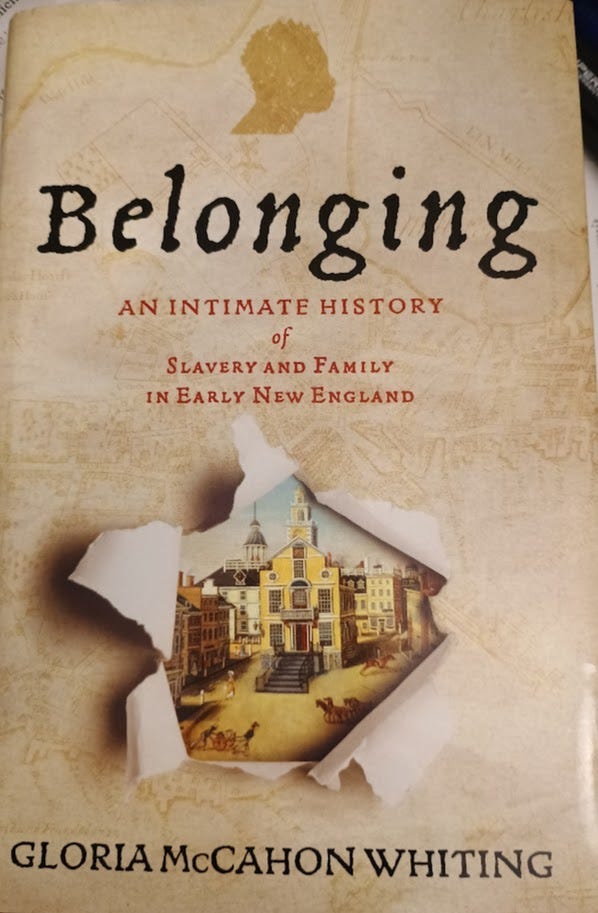
Today, I’m riffing on a book that’s excellent academic history, and also full of extraordinary stories well told. I’m talking Dr. Gloria McCahon Whiting’s Belonging: An Intimate History of Slavery and Family in Early New England. Belonging has knocked my socks off, and you know the best thing about it? It’s a great read! Tales posts are typically on-ramps to help you get into a scholarly book. This time, as sometimes happens, I’m almost embarrassed to give Belonging the NBH treatment, because it’s written to be accessible to normal people as well as to historians. As ever, all I do is re-tell a sampling of stories in my own inimitable way, with my comments and asides. The glory goes to Gloria Whiting, who dived deep into many archives, and resurfaced with fistfuls of stories that I really didn’t expect to have happened, much less survived in documents.
Today, I rewrite a sampling of Dr. Whiting’s stories, but I can’t puff myself up smugly, and imply I’m doing a better writing job than the author. So I hope she will forgive me, and that she will definitely not send a drone to drop a boulder on Non-Boring House.
Baby Sue was born at the turn of the 18th century, and she was born into a large family, headed by wealthy merchant and Massachusetts politician Elizur Holyoke. How big of a deal was Elizur Holyoke? His name would one day be on the map of Massachusetts, in the form of a hill named Mount Holyoke, and, much later, the far more famous Mount Holyoke College was named for that hill.
By the time Sue was born, Elizur’s wife Mary had given birth to eleven children, and eight of them were still alive. Sue was not one of those kids. Yes, she did belong to Elizur and Mary’s family, but not in the way you’re probably thinking. Eighteenth century families often included what we would consider unrelated people, people we would think of as employees. In fact, they were far more connected than the “families” modern corporations keep telling their employees they are.
Elizur and Mary were not Sue’s parents as today we would understand the word “parents”. Elizur Holyoke was not Sue’s biological, adoptive or foster father. He owned Sue, just as he owned her mother. That’s because Sue and her mum, whose name is not recorded in surviving records, were enslaved by Elizur Holyoke.
If Sue’s mother had been a European indentured servant, she would have become free after a few years of working for the Holyokes. Sue would not have been enslaved at all. But as an enslaved woman of African descent, Sue’s mum was sentenced to live her life for the benefit of the Holyokes, or whoever they sold or assigned her to. As the daughter of an enslaved woman, Sue was destined for the same fate, from the first moment she drew breath, until the second she gasped her last.
This didn’t turn out as we might expect. Fact is, the Holyokes didn’t want Sue at all. This might surprise you, and it certainly surprised me. When Sue was born, in the 1700s, babies born to enslaved women were considered valuable (in cash money terms) in the places where there were the most enslaved people. We’re talking the tobacco and rice fields of Britain’s Southern colonies like South Carolina and Virginia, and the sugar plantations of the British West Indies, like Barbados. But Sue was not born in these colonies. She was born in Massachusetts. One way in which New England slavery was different was that enslaved babies were born worth not much money, or no money at all.
Laing, that’s weird. How could enslaved babies be considered worthless in money terms, when enslaved people were considered property?
Good question, and the answer, like so much of history, is about context, the times and place in which Sue was born, lived, and died. Her life took place entirely within the 18th century, and entirely in Massachusetts. New England in the 1700s was a place in which people didn’t live the libertarian dream of being rugged individuals in wide-open spaces. They lived in various kinds of communities, starting with cities, towns, and villages, and many of them lived on small farms rubbing against their neighbors’ farms, and raising a wide range of crops, like wheat and vegetables and dairy, and animals, like pigs, cattle, and chickens. This made New England a very different place than Britain’s Southern colonies and its islands in the West Indies, where large factory-style plantations grew huge fields of a single crop, like tobacco or rice or sugar.
On big Southern and Island plantations, large numbers of people were forced to work. These had been mostly English people at first, on a limited-term contract of unfree labor, to repay the cost of bringing them across the Atlantic, people called indentured servants. More and more, as the supply of people willing to risk their lives in hot climates dried up, they were being replaced by enslaved people from Africa and captured Native people. Most, but not all, were men.
In the South and on the Islands, as more enslaved women arrived (and they were a trickle until later in the 18th century) those enslaved people who were too old or disabled to work in the fields acted as childminders, caring for babies and small kids. Their unpaid work meant that childcare cost wealthy enslavers almost nothing, so they could tolerate waiting for infants to become old enough to be put to work, usually at six or seven years old, or be sold for a handsome profit when they were older.
In New England, most enslaved people lived on small farms or in households, often in the homes of people who were what we might now think of as middle class, where they were typically the only enslaved person. I suddenly think of domestic servants in late 19th and early 20th century Britain: We think of big staffs in places that looked like Downton Abbey, but most domestic servants worked alone or in groups of two or three in middle-class homes.
In 18th century New England, most people were used to living at very close quarters. And that included enslaved people, who lived with their enslavers, eating dinner at the table with them, and maybe even sleeping in the same room. A typical enslaved woman in New England did domestic work. If she got pregnant, her baby was seen as a burden by her enslavers. That’s because she was sentenced to a life of domestic drudgery for the benefit of her enslavers, not living her own life or caring for her baby.
So, in 18th century New England, enslavers often placed ads in newspapers in which they offered babies for sale (cheap). Quite a few of these ads offered babies for free. Some even offered to pay someone to take away an enslaved baby. Yes, believe it or not, this was happening in Massachusetts, early America’s Bible belt, a Christian society where the family was at the center of God’s plan for human society. How on earth, we might wonder, did Massachusetts people justify enslaving others, much less the cruelty of separating mothers from babies? Even more amazing, how did New England later end up as the Ground Zero of the movement to abolish slavery? I can’t possibly even begin to tackle those questions in this post without dropping down massive rabbit holes. But I can get us started with some clues.
To us, eighteenth-century New England was an alien world. The emotional impact of separating mothers from babies was just not a serious consideration for most enslavers. I mean, even in recent times, it wasn’t a serious consideration. In early Massachusetts, skin color, alien culture, a person’s enslaved condition, and enslavers’ material self-interest branded mother and child as lesser humans at best, even though it was clear to anyone with eyes that this wasn’t true. Black babies were even born in the same circumstances as white babies in this overwhelmingly white society: Their mothers squatted on birthing stools, supported in the arms of other women, most of them white, and they delivered infants whom almost everyone understood were real babies. They were also immediately understood to be different, and destined to live lives apart.
Six weeks after her birth, little Sue Black (as she became known) was sold by Mary Holyoke for six shillings, the price of a pair of shoes or a wheelbarrow. The deal was done in a tavern, in the presence of Sue’s enslaved mother whose response, like her name, went unrecorded. Mary Holyoke, as seller, must have thought she got a very good deal from the baby’s purchaser: She got cash, and she didn’t have to give away Sue for free, or pay someone to take her away. She likely expected to get less than six shillings from Mary Norton, the buyer. Mary Norton, on the other hand, thought six shillings and raising a baby small prices to pay for the bargain of a servant who, once she was seven or so, would wait on her hand and foot for life.
So Sue’s mother, who had carried her baby through the streets of Boston, following Mary Holyoke, and who had watched the two women haggle over the cash value of her baby, was now forced to give her up to a stranger, Mary Norton. We don’t know if Sue’s mum pleaded for her child. We do know she was there. Unimaginable to me, a modern mother. But I cannot assume how she reacted: Maybe she saw Sue as a burden. Maybe she was just resigned to losing her. Maybe she sobbed as she handed over her daughter to a white stranger who saw her only as an investment. Again, the documents are silent.
And Sue? Separated from her mother and carried by ship from Boston to Manchester, about thirty miles up the coast, she would grow up in a family, but as a solitary child . She would be the only member of the Norton family who was enslaved, and the only child who was black. Was she even a member of the Norton family at all? By the standards of early New England, she was: Servants and slaves were regarded as members of a family, a household, which was considered first and foremost an economic unit rather than people bound by emotion and genetics. Just as in England, this kind of family was typically headed by a man, the only exceptions being women who were widowed or single. Grandparents, interestingly, typically lived in their own households.
Mary Norton was not the head of her family. That was her father, George, so long as he was alive, and then would be her mother, not her brother. Mary was young, a daughter of the family in which she lived, and her commitment to raising Sue to be her servant kind of came and went. Mary Norton later launched a lawsuit claiming an adult Sue and her descendants as her property, and that’s how Dr. Whiting prised this story from the historical record, and why she is able to share it with the world, and why I am able to write about it.
In general, we think of slavery in New England, if we think of it at all, as lower on the scale of awfulness than the brutal institution in places like South Carolina and Barbados. But maybe we need to consider New England’s slavery’s awfulness to be different, not better. While enslaved children born in South Carolina had a chance of staying with their mothers and within most of their extended family and community, enslaved kids in New England often grew up cut off from them all, mother included. Sue was one of those children. She was among about half of enslaved New England people who were the only enslaved people in a house.
Sue’s childhood was straight out of a Roald Dahl novel, only worse. Records show that she was verbally demeaned, constantly reminded that she was an outsider, and physically attacked with kicks and blows. No other enslaved people were on hand to comfort or support her. Only when she reached the age of seven would a child like Sue be regarded as useful. Until then, in the crucial years of childhood, an enslaved child who was the only black person in a free white household was very much alone. When I think about that, I think of little Sue as wee Hoosen, Jr., my son, and I weep.
Sometimes, enslavers seem to have had pangs of conscience: They asked in their ads for someone nearby to take a black child, if possible, so (presumably) child and mother could remain in contact. Some sold mother along with child, “which must go with her.” Or they offered a baby as a BOGO offer: Buy the mother, get a free baby.
Historians are about explaining rather than judging, but no reputable historian would be willing to defend the morality of slavery, or be so lacking in empathy as not to be moved by the horror of it all. Whether enslavers merely reflected the culture of their times, or whether they knew damn well what they were doing, remains debated. Dr. Whiting does not let enslavers off the hook, even when they tried to limit the harm they caused: “Black families were still dissolved to convenience white ones.” This was a choice for wealth enslavers made, not a necessity for living, and before we judge, I gently suggest, let us consider the times we have bought the cheapest good, not the one is fairly traded. Historians are well aware of the dangers of seeing faults in people of the past, to avoid seeing our own.
The impact of sale and slavery on an enslaved child, his or her mother, father, or caregiver, if any, was not an issue for most people who enslaved them. And when a baby was sold in a tavern in Boston in 1700, nobody batted an eye. This was normal. But it wasn’t normal, was it? Not for white babies, certainly. Not in a self-consciously Christian society founded on families. No wonder we sense ill-ease, even guilt, from those ads trying to dispose of babies.
Sue was only six weeks old when she was sold. Her life and Mary Norton’s six shillings investment were now very much in danger, since Sue’s mother would no longer be able to feed her. Mary Norton now had a stroke of good luck: Another guest at the same Boston inn, Penelope Hadlock, was, like Mary Norton, from Manchester, Massachusetts, and she agreed to feed Sue for five shillings, at least until they returned home.
Once Mary Norton arrived in Manchester with Sue, Mary hired a neighbor, Abigail Williams, to be Sue’s wet nurse. Sue was taken to live at the Williamses, where she stayed for about three months. This was a side gig for Abigail Williams, a white mother whose family, many years later, recalled her nursing a black baby. Wet nursing (as it was called) wasn’t an act of compassion, or a blow for Sue’s equality: It was a financial transaction.
If a white woman nursing a black baby in the 18th century seems surprising to us, that’s because this would indeed have been highly unusual in the South, where few poor whites lived by the slave labor camps that housed large African populations, and where there were enslaved women available to breastfeed an enslaved child. In New England, most of women who were able and available to breastfeed were white. In all areas, black women often breastfed white babies. Some enslavers in New England may have wanted rid of black babies so that the women they enslaved could earn money for them by nursing white children, although this was rare, assuming it ever happened: There were plenty of white wet nurses in New England, white women who made a little extra money by taking in babies, and competition kept their prices low.
Once Sue was about six months old, Mary Norton collected her from Abigail Williams, and started her on a dodgy diet of “pap”, which was breadcrumbs or flour mixed with water, cow’s milk, or broth. Had she been kept with her mother, Dr. Whiting, suggests, Sue would likely have remained on more nutritious breastmilk for several more months. But I doubt many people in the early 18th century grasped why that mattered, and, remember, not much value was attached to an enslaved black child.
Living with Mary Norton and her parents, baby Sue does seem to have been cared for: She was wrapped in blankets against the cold, and was seen by a neighbor lying across Mary’s lap. Mary paid a local man to build Sue a little wheeled mobility device to help her learn to walk. As Sue got older, Mary (or someone else) may have taught Sue to read, maybe a little writing and math. None of this meant that Sue truly belonged.
Sue was not surnamed Norton, the family name, but called Sue Black, a name reflecting her skin color. Curious visitors never stopped asking—in Sue’s hearing—why the Nortons kept a black child. How did that happen, they asked? Mary would tell them the story of buying Sue in Boston. Other Norton family members wondered why they had to tolerate the awkward presence of a small black child, an object of curiosity and gossip about the family. Mary’s mother resented having to pitch in with childcare, and Mary’s brothers, according to a witness, kicked little Sue and told her to get lost.
By then, by the time Sue was out of babyhood, Mary Norton was gone from the home. Soon after Sue turned one, Mary —already five months pregnant —was married. Had she lost interest in Sue? Had buying this black child been a teenage whim, a bad investment? Whether for sentimental reasons or for the return on her six shillings, Mary wanted Sue to live with her, but her mother—the same mother who had resented the black baby in her household— now asked to keep Sue and raise her, saying she had changed her mind because “she had taken such a fancy to it that she did not know how to part with it.” Notice the “it”.
Maybe Mary’s mother had become attached to Sue. Maybe she was worried how Mary would cope with two babies, her own and Sue. Most likely, however, Mrs. Norton was picturing a future with Sue as her own slave. So Mary and her mother struck a deal: Sue would remain in the Norton household, where her mother would raise her. Once Sue was old enough, she would work for Mrs. Norton (or be hired out to work elsewhere for her profit). When Mrs. Norton died, ownership of Sue would return to Mary.
As Sue grew, by the time she was seven or so, she worked for the Nortons, and especially for Mrs. Norton. She washed clothes and ironed them. She cooked and brewed beer. She milked cows, and made candles. She spun thread and sewed clothes. “By the time she was a young woman,” Dr. Whiting writes, “Sue had made herself indispensable to the household.”
Being a pillar of the Norton family did not protect or free Sue, or the three sons she bore as an adult. Her first child, Abijah (a Biblical name Sue may not have chosen) was sold three times before he was six years old. Abijah remained in the area, near his mother, but that was by no means guaranteed: When he turned seven (and could be sold for a profit) the woman of the couple who enslaved him suggested selling him South, to the tobacco fields of Virginia. Whether or not Sue knew of this threat is not clear.
While pregnant with her second child, Jethro, Sue herself was sold to Mrs. Norton’s son, one of the same boys who had bullied her as a youngster. When Jethro was still a toddler, he, too, was sold, to a local man in Manchester. By now, Sue was pregnant with her third son Matthew. And while she was expecting, Mary Norton sued to reclaim Sue and all of her sons as her property. And won. Sue’s family was still enslaved, however, and was not reunited.
Annette’s Aside: Agency and Sources
When historians try to show how truly horrific slavery was, we risk portraying enslaved people only as powerless victims. If we focus on what we call agency, on enslaved people working to gain as much control as possible in their lives, we worry that people will conclude that slavery wasn’t so bad. This is the sort of problem that keeps historians awake at night: How do we show that slavery was horrific, and that people pushed back for control?
And then there’s this problem: How do we recover the voices and actions of enslaved people themselves, when most documents were written by enslavers, or people sympathetic to slavery? The good news is that we can get a lot of info from those same documents, by learning (as we do) to read through them, using empathy and imagination as well as knowledge.
Here’s one example: When Virginia enslaver William Byrd wrote of whipping “his” slave, a young boy named Eugene, for wetting the bed, and of forcing the kid to drink his own urine, we not only can get a sense that Byrd was a sadistic tyrant, but of Eugene’s perspective: His bedwetting was likely set off by the his fear of brutal punishment. This is not to say that getting at truth about the lives of enslaved people is easy, even when we have the voices of the enslaved themselves.
I remember, when I was in my twenties, picking up a book of interviews from the 1930s, conducted with formerly enslaved people under the auspices of the Federal Writers’ Project, a New Deal program that employed young writers to build a historical record, and to broaden people’s understanding of American history.
I was shocked by what I read in those interviews. Formerly enslaved people often downplayed the horrors of slavery, and even expressed nostalgia for the olden days of slavery. They sounded like ambassadors for the Daughters of the Confederacy, not traumatized people. This made no sense at all, and I decided not to put any stock in these interviews. Only years later did I come to understand what had happened, and here’s one clue: The interviewers were typically college-educated young white professionals, and the interviewees were poor, black, elderly, and living in the South. Talking about the FWP interviews could be several posts by itself, and one of the things we need to talk about here at NBH is how historians work with imperfect sources—which all of them are.
What did Sue make of her life, surely a lonely and powerless one? On that, the archives are silent. But in every other chapter of this book, Dr. Whiting shows enslaved people in colonial New England taking action to hold their families and communities together, to protect each other.
Self-defense in a system in which enslavers had absolute power over people could be drastic. In Massachusetts in 1755, an enslaved man named Mark and his friends Phillis and Phoebe worked together to end the rule of their abusive enslaver, a man who raped the enslaved women in his household and prevented Mark from visiting his wife. These three enslaved people’s situation seemed hopeless, so they took the only route they could think of: murder. Theirs is a startling story, and, like most such stories, did not end well for anyone, especially the enslaved people who fought back. This also helps us understand why violence was not the first choice of enslaved people who pushed back against slavery.
So if they couldn’t just off the person who enslaved them, and if escape seemed impossible or undesirable (where would fleeing enslaved people go in 1700?), then what could they do? The answer is that they did a lot to reclaim their lives, even in the South. But this being New England, where black people were minorities in their communities, where they were used to dealing with white people directly, the stories are especially complicated and fascinating.
Take the Vassalls. They were a black family in mid-18th century Boston who were enslaved by a white family of the same name. In this story, it was the white people who ran away. The white Vassalls decided to remain loyal to Britain during the American Revolution, and fled to their estates in the West Indies, which had not joined in with the mainland colonies in rebelling against London, and to England itself. They left behind their house and land in Cambridge, the Boston suburb that was and is home to Harvard University, along with the people they enslaved.
The black Vassalls stayed where they were. Well, most of them did: Little Darby, aged six, was another story. As a baby, he, like so many black babies, had been taken from his mother and family, and given away to an enslaver named George Reed, Jr., who lived about ten miles away in Woburn (Brits: Yes, named after the one in Bedfordshire, now part of Milton Keynes, but pronounced Wooburn in Massachusetts). Young Derby somehow learned who his family were, and where they lived.
So, on the death of George Reed, this six-year-old boy walked alone through war-torn Massachusetts. He headed for Boston, even as refugees poured out of the city in search of safety, walking through the countryside. Nobody seems to have bothered the lad. In New England, unlike the South, a black person of any age walking alone did not excite suspicion of being an escaped slave, even though that was what Darby was.
On the way, he would have passed the sun bleached skelton of Mark, who had been executed for the murder of his enslaver, and whose corpse had been hung in chains after he was hanged, twenty years earlier, as a warning to other enslaved people who might consider rebelling. Did Darby find Mark’s bones and fate disturbing, Dr. Whiting asks? Or did he just register this macabre sight as a well-known local landmark, reassurance that he was going the right way? Some questions have to remain unanswered, awaiting the recovery of documents that probably don’t exist.
What is known, Dr. Whiting tells us, is that little Darby made it to his real home, a massive mansion owned by the Vassall family who had enslaved his parents, and fled without any of their property, including Darby’s parents and siblings.
Sometime soon after, the Vassall house became the Boston HQ for George Washington. The black Vassall family kept busy, so nobody would ask awkward questions about their presence. The story (maybe true, maybe not) goes that Washington, an enslaver himself, spotted young Darby playing outdoors, ordered him inside, to ask for something to do. Darby—according to the story—asked Washington how much he would be paid for his work.
Folklore it might be (and probably is, TBH) but that story points to something that was true: The moment George Reed, Jr. died in the middle of the upheaval of the War for Independence, Darby Vassall, all of six years old, had understood that he was free, that he could go live with his real family, and have a normal life. He wasn’t about to have that freedom taken from him, and thanks to his parents’ brilliant maneuvers through the upheaval of wartime, he did not.
The black Vassall family farmed the land attached to the house, which did not provoke any suspicion. Darby’s father, Anthony (Tony) Vassall, simply told the local authorities, who had confiscated the house when the white Vassalls left, and rented it to Washington, that he was a free man. He did not claim that his wife and kids were free, because he now made the clever argument that his family actually belonged to the local government, who would have to feed and clothe them. So he offered to take over that irksome responsibility as family patriarch, if the government would compensate him for his trouble. A government official bought his argument, and gave Tony the astonishing sum of £222.
Tony went further, repeatedly petitioning the Massachusetts state legislature for title to the land that had been abandoned by the white Vassalls, and which the black Vassalls had improved by farming, so gaining a claim to ownership. That’s what they had been busy doing under Washington’s nose. Tony Vassall framed his claims for more support not as pleas for charity, but pointing out that although he and his wife, Cuba, were “dwelling in a land of freedom”, they had spent a total of sixty years enslaved. He was, in short, demanding reparations, and pointing to how the new United States was framing itself as a land of liberty.
The legislature did not give Tony Vassall land title, but they did promise him twenty-four pounds a year. That meant that even when the Vassall estate was sold and the family evicted in 1781, Anthony Vassall could now afford to buy a good house, to which he added several acres of land over the next several years. He had been coachman to the white Vassalls, so he had the skills of a farrier, and took up shoeing, grooming, and boarding horses, on his own property, along with farming.
Anthony and Cuba Vassall were now a respectable family. And that’s how Darby Vassall grew up learning his father’s trade as a farrier and as a farmer, as well as living in a furnished house, and sleeping on a feather bed. That’s also how he entered adult life with a little insurance in the form of family wealth.
By 1806, Darby was married to Lucy, with five children, and living in Boston in his own house. He was a leader and advocate for Boston’s Black community, and during the Haitian Revolution, he raised a toast to a future day “when the color of man shall no longer be a pretext for depriving him of his liberty.” Years later, Darby Vassall led Boston’s black citizens’ opposition to the Fugitive Slave Act, which enabled Southern enslavers and their hired goons to kidnap any and all black people off the streets of Northern cities based on often made-up claims to their being someone’s property.
For all his efforts, Darby Vassall, former brave little kid who walked from slavery to home, became affectionately known to Black Bostonians as Daddy Vassall. What became of him in his old age is also a compelling story, and a great reason to get yourself a copy of Dr. Whiting’s book!
If this post has caught your attention, I highly recommend Gloria McCahon Whiting’s Belonging as a highly readable work of academic history, crammed full of stories about slavery and enslaved people in the very different (or maybe not so different?) culture and society of early New England.
I’ve written about slavery in New England before at NBH, riffing on Dr. T.H. Breen’s great essay on the subject. This is one of hundreds of posts available to subscribers to Non-Boring History.

My name’s Annette Laing, I hold a PhD in early American and modern British history, I quit my job as a tenured professor back in 2008, and, after many years of writing the Snipesville series of time-travel novels, and entertaining and engaging thousands of kids, teens, teachers, and families with actual history, I now write Non-Boring History for you! Readers’ support for my unique mission is essential to my work, and I continue to need more readers to step up. When you become a subscriber (annual, monthly, or patron) You get a guarantee that you’re on the mailing list, and a whole world of NBH.
Oh, and do check out the exciting new Subscriber Perks page at Non-Boring History! This is just the start, with even more perks to come, including exclusives for subscribers at every level. There’s even an offer for first-time new subscribers! Take a look, and see if the Non-Boring House Gnomes and I can tempt you to . . .
This is so moving - wonderfully told, as always. I am trying to steel myself to buy the book ..,
… (cont.) to visualize the settings and empathize with the white and black characters involved.